
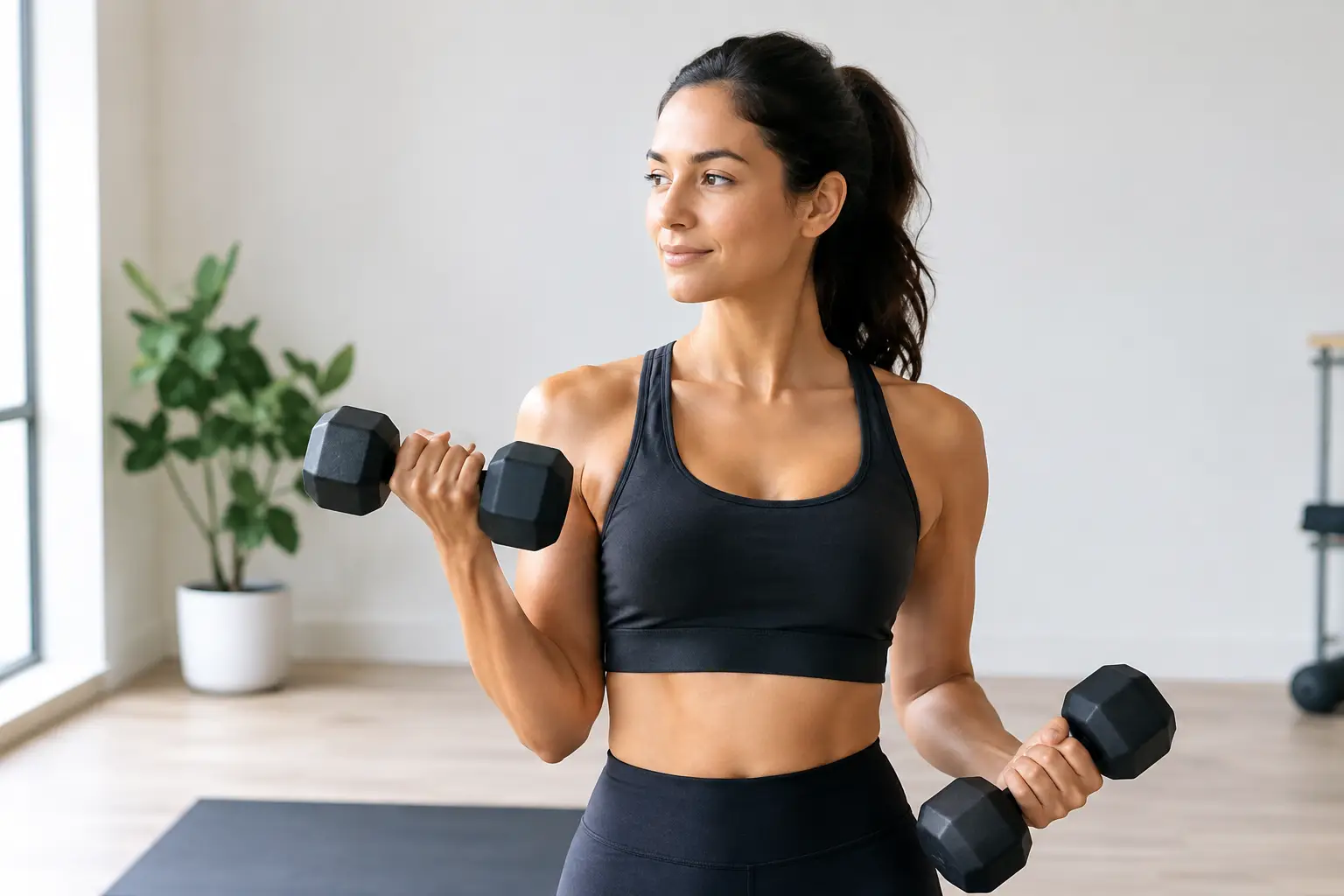
A pair of dumbbells can turn a spare 25 minutes between meetings, school pickup, or a night shift into meaningful strength work. The real question is not whether you have the perfect setup. It is how to train with dumbbells in a way that feels safe, effective, and realistic enough to repeat next week.
Dumbbell training meets you where you are. You can start light, train one side at a time, adjust exercises around sore joints, and make progress without building your life around the gym. The goal is not to leave every workout exhausted. It is to become stronger for the life you already have.
Table of Contents
- Why dumbbells work for real-life strength
- How to choose a starting weight
- A step-by-step way to train with dumbbells
- A simple full-body dumbbell workout
- How to progress without overdoing it
- Frequently asked questions
Image suggestion: A diverse group of adults, including a woman in her 50s, a young Black man, and an Asian father, training with dumbbells in a bright, approachable home or community gym setting.
Why Dumbbells Work for Real-Life Strength
Dumbbells ask each side of your body to contribute. That matters because daily life is rarely perfectly balanced: you carry groceries on one side, lift a child from an awkward angle, or reach into the back seat of a car. Unlike a barbell, dumbbells can move independently, which may reveal and gradually improve side-to-side differences in strength and control.
They also offer useful flexibility. A bench is helpful but not required. You can train standing, on the floor, or from a sturdy chair. For someone returning to exercise after a long break, that lower barrier can be the difference between a plan that stays on paper and one that becomes part of the week.
There is a trade-off. Dumbbells can feel less stable than machines, so lighter weights may challenge you more than expected. That is not a weakness or a reason to rush toward heavier weights. It is your body learning coordination along with strength.
How to Choose a Starting Weight
Choose a weight that lets you complete your planned repetitions with steady form while leaving roughly two to three repetitions in reserve. In plain language, the final few reps should feel challenging, but you should not need to twist, hold your breath, or throw the weight around to finish.
For many beginners, having two or three pairs of dumbbells works better than buying one heavy set. Your legs can usually handle more load for squats and deadlifts than your shoulders can for presses or raises. Adjustable dumbbells are another practical option when space is limited.
Use the first set as information. If you could have easily done 10 more repetitions, go a little heavier next time. If your form falls apart halfway through, reduce the weight, lower the rep target, or choose a simpler variation. Training is not a test you pass or fail. It is feedback.
How to Train With Dumbbells: 5 Simple Steps
1. Start with movement patterns, not random exercises
A well-rounded dumbbell session usually includes a squat, a hinge, a push, a pull, and a core or carry movement. These patterns cover much of what your body needs for everyday strength.
A squat might be a goblet squat. A hinge might be a dumbbell Romanian deadlift. Push options include a floor press or overhead press, while a one-arm row covers pulling. For core stability, try a suitcase carry by holding one dumbbell at your side while walking slowly and standing tall.
You do not need every variation in every workout. Start with four or five movements you can perform confidently and repeat them long enough to learn them.
2. Warm up for the session you are about to do
You do not need an elaborate 20-minute warm-up. Spend five minutes raising your body temperature and rehearsing the motions ahead. Walk briskly, march in place, or climb stairs, then do a few bodyweight squats, hip hinges, arm circles, and easy rows with very light dumbbells.
The purpose is preparation, not fatigue. If you are stiff from a desk-heavy day, move a little longer and use a lighter first working set. If you are short on time, two focused minutes are still better than skipping preparation altogether.
3. Use controlled repetitions
For most exercises, lower the dumbbell with control, pause briefly if you need to reset, then lift smoothly. Keep your ribs stacked over your pelvis rather than flaring your chest or arching your low back to force a rep.
Breathing can help. Exhale during the effort, such as standing up from a squat or pressing the weights overhead. Inhale as you return to the starting position. You do not need to make every rep look identical, but pain, sharp pinching, dizziness, or repeated loss of control are signals to stop and adjust.
4. Train close to effort, not to collapse
Two to four sets of 8 to 12 repetitions is a useful starting range for many dumbbell exercises. Heavier work may fit better in the 6 to 8 range, while smaller movements such as lateral raises may feel better at 10 to 15 controlled reps.
Rest about 60 to 90 seconds between sets, or longer if your breathing is still too elevated to focus on form. On demanding days, one or two solid sets can be enough. A shorter workout that respects your energy and recovery is far more useful than an ambitious plan you dread.
5. Schedule recovery as part of the program
Strength improves between workouts, not only during them. Most people do well with two or three full-body dumbbell sessions per week, with at least a day between hard sessions for the same muscle groups.
Sleep, food, hydration, stress, and work demands all influence recovery. If you are caring for a sick child, working overtime, or sleeping poorly, reduce the number of sets or use lighter weights. Adjusting is not quitting. It is how sustainable training works.
A Simple Full-Body Dumbbell Workout
Try this workout two days per week for three to four weeks. Begin with two sets of each exercise. Rest as needed, and use a load that keeps your technique steady.
- Goblet squat – 8 to 12 reps. Hold one dumbbell close to your chest and sit down between your hips.
- Dumbbell Romanian deadlift – 8 to 12 reps. Slide your hips back while keeping the weights close to your legs and your back long.
- Dumbbell floor press – 8 to 12 reps. Lie on the floor, press the weights up, and keep your wrists stacked over your elbows.
- One-arm dumbbell row – 8 to 12 reps per side. Support yourself on a chair or bench if needed, then pull your elbow toward your hip.
- Standing overhead press – 6 to 10 reps. Press only through a comfortable range. If overhead pressing bothers your shoulders, repeat the floor press instead.
- Suitcase carry – 20 to 40 seconds per side. Walk slowly with one dumbbell at your side and resist leaning toward it.
If this feels like too much at first, do the squat, row, floor press, and carry. Four movements done consistently can build a strong foundation.
How to Progress Without Overdoing It
Progress does not always mean adding weight. You can add one or two repetitions, improve your range of motion, slow the lowering phase, perform an extra set, or simply feel more stable using the same dumbbells. Those are real signs that your body is adapting.
When you can reach the top of your rep range for every set with clear form and still have several repetitions left, increase the weight slightly. If you do not have heavier dumbbells, add reps gradually or use single-leg and single-arm variations. A split squat or single-arm floor press can create a meaningful challenge with modest equipment.
Avoid changing every exercise every week. Variety can keep training interesting, but repetition builds skill. Give yourself enough time to notice that a movement is becoming smoother, stronger, and less intimidating.
A Closing Thought
Your dumbbell routine does not need to look impressive to anyone else. It needs to support the person you want to be outside the workout: more capable on busy mornings, more confident in your body, and more resilient when life gets demanding. Start with the weights and time you have, then let consistency do the quiet work.
Frequently Asked Questions
Can I build muscle by training only with dumbbells?
Yes. Dumbbells can build muscle when your sets are challenging, your form is consistent, and you gradually increase the training demand over time. Very strong or experienced lifters may eventually need heavier loads or other equipment for certain movements, but most people can make substantial progress with dumbbells.
How often should beginners train with dumbbells?
Two full-body sessions per week is an effective, manageable place to start. Add a third session only when you are recovering well and the routine feels sustainable alongside your work, family, and sleep needs.
Should I use light weights for toning?
The word “toning” usually describes having some muscle along with a level of body fat that allows muscle shape to show. Light weights can be useful, especially while learning technique, but muscle growth requires enough challenge. Choose a weight that makes the last few reps difficult with good form.
What should I do if dumbbell exercises hurt my joints?
Stop the painful movement and do not push through sharp or worsening pain. Check your range of motion, reduce the load, slow down, or try a different exercise variation. If pain continues, worsens, follows an injury, or affects daily activity, consult a qualified health professional.
For more exercise tips, read The Resilient Athlete: A Self-Coaching Guide to Next Level Performance in Sports & Life by Andrejs Birjukovs.