
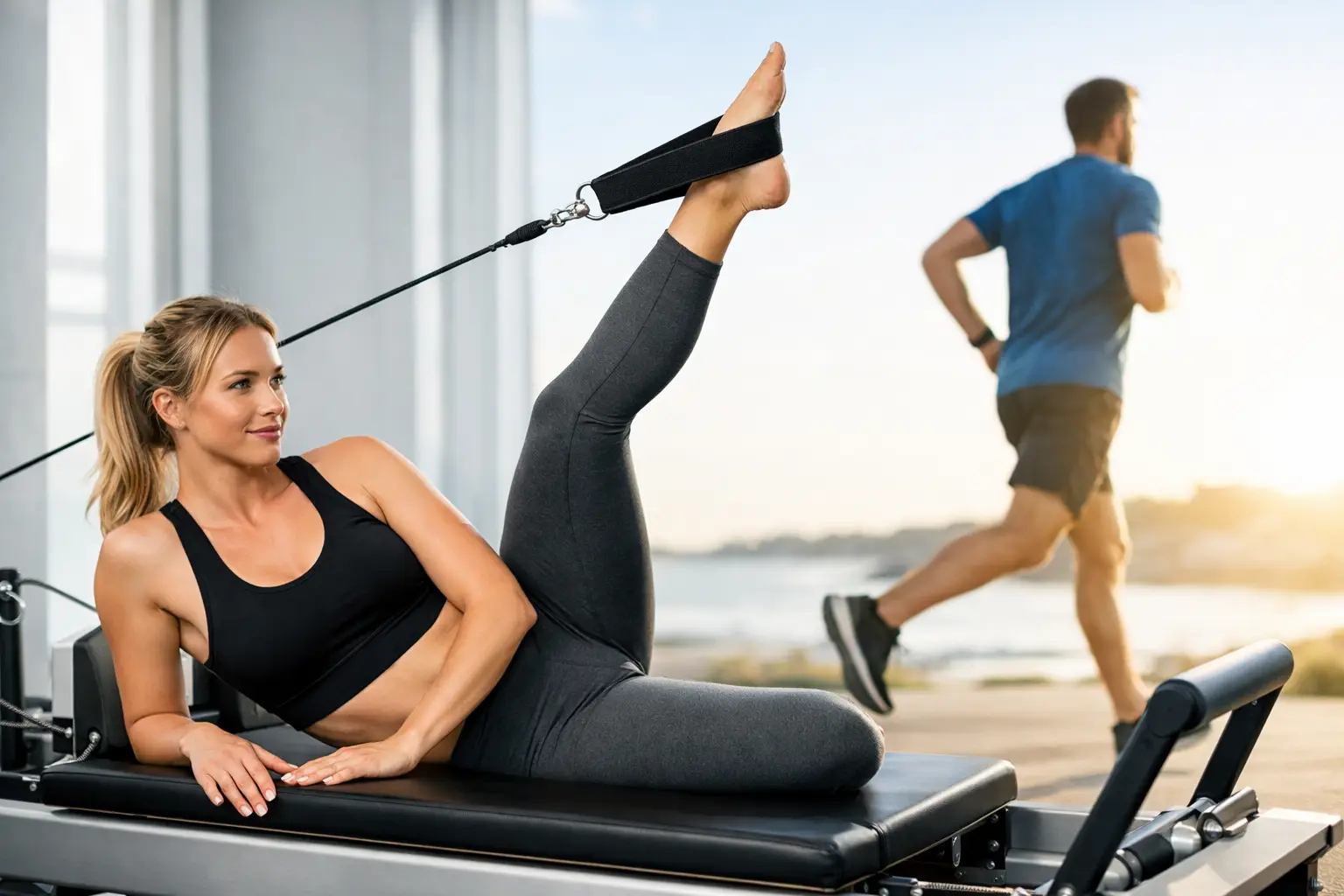
A run can feel great until the familiar tight hip, sore low back, or wobbly knee shows up halfway through your week. More miles are not always the answer. Pilates for runners can fill an often-missed gap: the strength, body awareness, and control that help your running form hold together when you get tired.
It is not a replacement for running workouts, strength training, rest, or medical care when you are injured. Think of it as supportive training – a practical way to move better between runs without adding another punishing session to an already full schedule.
Table of Contents
- Why runners benefit from Pilates
- What Pilates can and cannot do
- Pilates exercises runners should prioritize
- How to add Pilates to a running week
- Signs to scale back
- A steadier way to support your running
- Frequently asked questions
Why Pilates for Runners Works
Running is repetitive. That repetition is part of its appeal: lace up, head out, settle into a rhythm. But every stride also asks your hips, feet, trunk, and upper body to coordinate quickly on one leg. When one area lacks strength, mobility, or control, another area may pick up the slack.
Pilates emphasizes controlled movement, breathing, alignment, and deep muscular endurance. For runners, that often means learning to keep the pelvis steady while a leg moves, maintain trunk control without holding your breath, and use the hips rather than relying only on the low back or front of the thighs.
The goal is not to create a perfectly still body or chase “perfect form.” Bodies move differently, and your stride will not look identical to someone else’s. The useful question is whether you can run comfortably and efficiently enough for your current goals, then recover well enough to do it again.
Pilates can be especially helpful if you spend much of the day sitting, notice one side feels less stable than the other, or have returned to running after a busy season, pregnancy, illness, or injury clearance. It also offers a lower-impact training option on days when another hard workout would leave you more depleted than stronger.
What Pilates Can and Cannot Do
A consistent Pilates practice may improve muscular endurance, balance, joint awareness, and comfort with movements that runners often avoid, such as rotation, single-leg work, and controlled hip extension. Mat sessions can also be a useful reset for runners who tend to treat every workout as a test.
Still, Pilates is not a magic shield against injuries. Training load, sleep, nutrition, footwear, running surface, stress, prior injury, and the speed of your mileage increases all matter. If you sharply increase your long run and add a challenging Pilates class on top, your body does not care that one session was marketed as “low impact.” It only recognizes total demand.
Pilates also does not fully replace progressive strength work for runners who need more force production. Exercises such as squats, deadlifts, step-ups, calf raises, and loaded carries can build capacity in ways bodyweight Pilates may not. The strongest plan may include both, adjusted to your experience, available time, and race goals.
If pain is sharp, worsening, causes you to limp, or changes your ability to bear weight, pause the exercise and speak with a qualified health professional. Working around every symptom is not the same as recovery.
Pilates Exercises Runners Should Prioritize
You do not need an hour of advanced choreography to benefit. Start with a few movements you can perform slowly and consistently. Quality matters more than making an exercise look difficult.
- Glute bridge with a slow lower. Lie on your back with knees bent and feet hip-width apart. Press through your feet to lift your hips, keeping your ribs from flaring. Pause, then lower slowly. This builds hip-extension strength and helps you notice whether your hamstrings or low back are trying to do all the work.
- Dead bug. On your back, bring your knees over your hips and arms toward the ceiling. Gently exhale as you lower one heel and the opposite arm, then return. Keep the range small enough that your back does not arch. This teaches trunk control while the limbs move, a useful skill in every stride.
- Side-lying leg lift. Lie on one side with legs long and stacked. Lift the top leg without rolling your pelvis backward. You should feel the outer hip working, not a cramp in your waist. This movement targets hip stability that can be challenged during single-leg landing.
- Bird dog. Begin on hands and knees, then reach one arm and the opposite leg away from your body. Resist shifting your weight or twisting through the torso. Move deliberately rather than reaching as far as possible.
- Single-leg bridge or march. Once a standard bridge feels controlled, lift one foot slightly or alternate small marching movements at the top. This adds a single-leg challenge without the impact of running. If your pelvis drops or your back tightens, return to the basic bridge.
- Calf raises with balance. Rise onto the balls of both feet, pause, and lower over three seconds. Progress to one leg as tolerated, using a wall or chair for support. Your calves and feet absorb and return force with every run, so they deserve focused attention.
- Thoracic rotation. From a side-lying or hands-and-knees position, rotate through the upper back while keeping the lower body steady. Runners do not need exaggerated twisting, but comfortable upper-body rotation can make it easier to avoid a stiff, tense posture.
Reformer Pilates can add resistance and feedback, while mat Pilates is accessible at home with little equipment. Neither option is automatically better. Choose the version you can perform with sound instruction and repeat often enough to learn from it.
How to Add Pilates to Your Running Week
The most sustainable approach is usually smaller than people expect. Two 20- to 30-minute sessions per week can be plenty, particularly when you are new to Pilates or building toward a race. Put one session after an easy run if it is short and technique-focused, and schedule the other on a non-running day or after your hardest workout has passed.
A simple starting structure looks like this:
- Week 1-2: One 20-minute session, focusing on bridges, dead bugs, side-lying work, and calf raises.
- Week 3-4: Add a second short session or a few controlled single-leg variations.
- Week 5 and beyond: Maintain two sessions, or reduce volume during demanding race weeks while keeping a few familiar movements.
Avoid introducing a hard class right before a long run, speed session, or race. Pilates can create real soreness, especially in the hips, abs, and inner thighs. Give yourself room to learn how your body responds before treating it as an extra challenge.
For working parents, shift workers, and anyone with an unpredictable schedule, a 10-minute movement block still counts. Do one set of bridges, dead bugs, side-lying lifts, and calf raises while dinner is in the oven or before your shower. A modest routine practiced for months will do more for your running than a perfect plan you only manage twice.
Signs to Scale Back
Pilates should leave you feeling worked, more connected to your body, and generally able to continue your training. It should not turn every run into a negotiation with soreness. Scale back the range, repetitions, or frequency if you notice persistent fatigue, declining running performance, sleep disruption, or soreness that changes your gait.
Be cautious with aggressive stretching, deep spinal flexion, and advanced exercises if they do not feel good in your body. More range of motion is not always more useful. Runners who are already mobile may benefit more from stability and strength than from pushing further into a stretch.
A skilled instructor can offer modifications, but you are still the expert on your own signals. You do not need to earn a workout by ignoring discomfort.
A Steadier Way to Support Your Running
Pilates is most valuable when it helps running fit into a healthier life, not when it becomes another standard you feel pressured to meet. Use it to build steadier hips, a stronger trunk, and a calmer relationship with the work between miles.
Start with two or three movements, repeat them long enough to feel more capable, and adjust when life gets busy. Running progress is rarely about doing everything. It is about doing the few things that support your body well, again and again.
Frequently Asked Questions
Is Pilates good for runners who are beginners?
Yes. Beginners can start with foundational mat exercises and short sessions. Focus on breathing, control, and comfortable ranges of motion rather than advanced movements or high repetition counts.
How often should runners do Pilates?
Most runners do well with one to two sessions per week. Twenty to 30 minutes is enough to build consistency. During high-mileage weeks or race preparation, shorter maintenance sessions may be a better fit.
Should I do Pilates before or after running?
A short, gentle session can work as a warm-up before an easy run, but save demanding Pilates work for after an easy run or a separate day. Avoid tiring your legs and trunk before speed work, a long run, or a race.
Can Pilates help with running injuries?
Pilates may support rehabilitation by improving strength and movement control, but it is not a diagnosis or standalone treatment. If you have ongoing, sharp, or worsening pain, consult a licensed clinician who can assess your specific situation.
Is reformer Pilates better than mat Pilates for runners?
Not necessarily. Reformer work offers adjustable resistance and guidance, while mat Pilates is convenient and effective for foundational control. The better choice is the one that matches your needs, budget, access, and ability to practice consistently.
For more, consider Pilates for Runners by Sean Vigue.