
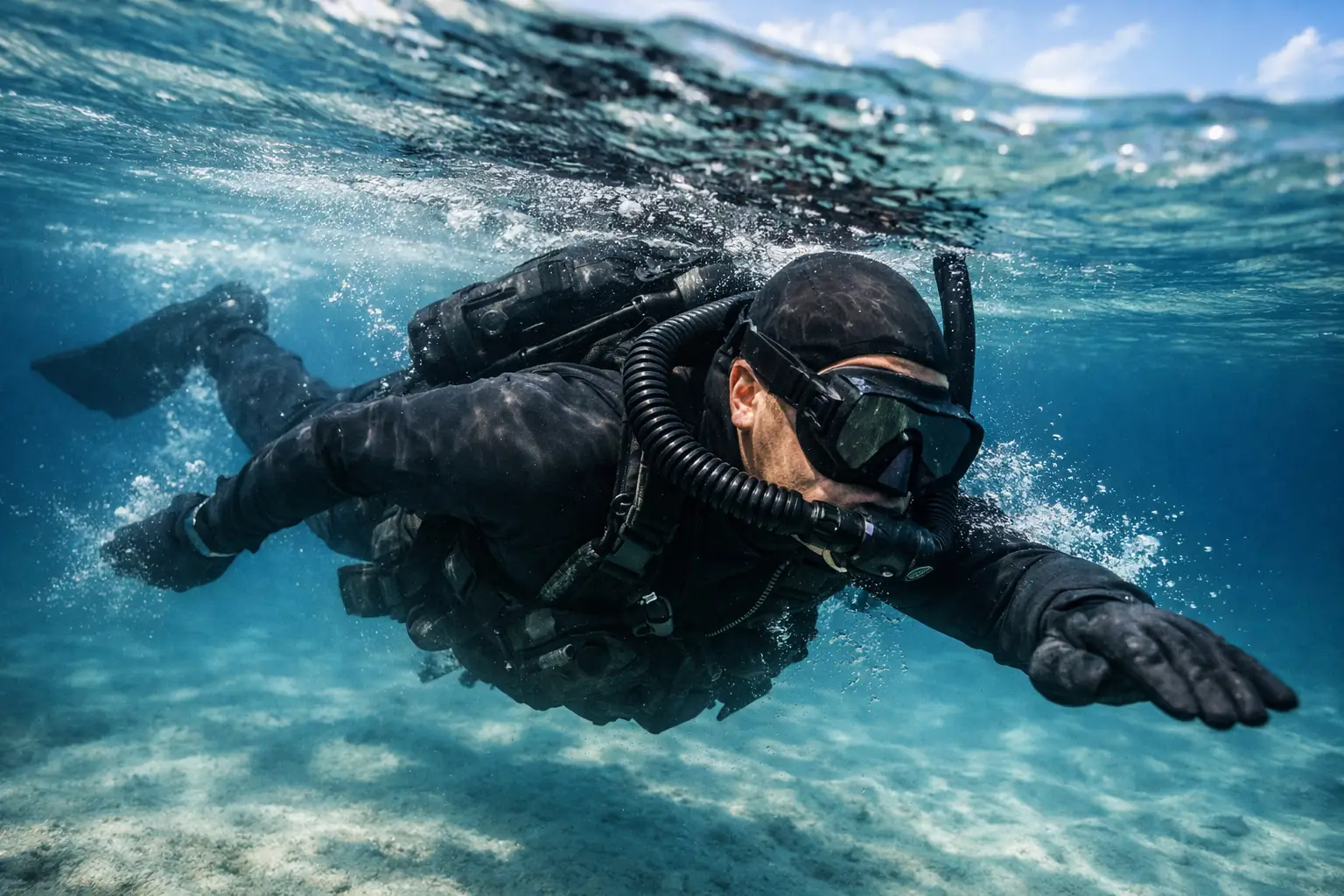
The Navy SEAL combat side stroke (CSS) has a reputation for being brutally hard. In reality, its challenge is more subtle: it asks you to move through the water with control, rhythm, and patience instead of muscling your way across the pool. That can make it a smart skill to learn for lap swimmers, military-fitness fans, and anyone who wants conditioning that feels purposeful without pounding their joints.
Table of Contents
- What the combat side stroke is
- Why the stroke is so efficient
- How to learn the combat side stroke
- Common mistakes and safer modifications
- How to program it into your routine
- Frequently asked questions
What Is the Navy SEAL Combat Side Stroke?
The stroke is often called the CSS. It combines elements of the traditional sidestroke, breaststroke, and freestyle. One arm reaches forward while the other stays closer to the body; the legs use a scissor kick; then the swimmer glides briefly before repeating.
That glide is the point. Rather than taking a breath every few seconds with your face in the water, you remain mostly on one side with your mouth clear of the surface. This allows for steadier breathing and a calmer effort level over longer distances. In military training, efficiency matters because swimming may involve distance, equipment, and fatigue. For everyday fitness, the appeal is simpler: it can build aerobic capacity while giving your shoulders and lower body a different challenge than freestyle laps.
The CSS is not a shortcut to elite conditioning, and it is not automatically the best stroke for every swimmer. Competitive swimmers may get more speed from freestyle, while beginners may initially find the coordination awkward. But for sustainable pool conditioning, its low-splash, measured rhythm can be remarkably useful.
Why This Stroke Feels Different
Freestyle rewards continuous turnover. The combat side stroke rewards a strong pull, a clean kick, and a streamlined pause. You do not want to rush through the recovery. You want each cycle to move you far enough that you can relax for a moment before the next one.
The stroke also distributes effort across the body. The lead arm helps you reach and catch water. The trailing arm contributes a compact pull near your torso. Your scissor kick creates a burst of propulsion, and your trunk keeps the body long and balanced. The result is a full-body movement that emphasizes timing more than raw force.
Because the face stays out of the water, many people find the breathing less stressful than freestyle. Still, that does not mean it is effortless. Poor body position can make the hips sink, and an oversized scissor kick can tire the inner thighs and hip flexors quickly. Think smooth and economical, not dramatic.
How to Learn the Combat Side Stroke
If you are new to lap swimming, first make sure you can comfortably float, kick, and swim one pool length using a stroke you already know. Practice in a supervised pool when possible, stay in a depth where you can safely stand, and skip the session if you feel dizzy, unusually short of breath, or panicked in the water.
1. Find a relaxed side position
Start by floating on your right side with your right arm extended in front of you, roughly in line with your shoulder. Keep your right ear near that arm and look slightly forward, not straight up at the ceiling. Your left arm should rest along your left side.
Aim to keep your hips close to the surface. A gentle squeeze through the glutes and a long spine can help. If your legs keep dropping, practice side kicks with a kickboard or use fins temporarily to learn the feeling of being horizontal.
2. Practice the scissor kick separately
From that side position, slowly separate your legs. Bring the top leg forward and the bottom leg slightly back, creating a narrow open shape. Then snap the legs together and point the toes as they meet.
The kick should feel like closing a pair of scissors, not like pedaling a bicycle. Keep it controlled. A huge split may feel powerful for one repetition, but it usually creates drag and can strain the groin if you force the range.
3. Add the arm action
Keep the lead arm extended as long as possible. As you begin the pull, bend that arm and sweep it down and back toward your chest. At the same time, bring the trailing arm forward along your side, then extend it to replace the lead arm.
The arms trade places. One reaches forward while the other finishes the pull near your torso. Your hands do not need to make exaggerated circles. Compact, deliberate movements are easier to coordinate and kinder to tired shoulders.
4. Connect pull, kick, and glide
As your arms come toward the center of your body, perform the scissor kick. Then extend into a long, narrow side position and glide. A useful rhythm is: pull, kick, glide.
Start with a longer glide than you think you need. Count one or two quiet seconds before beginning the next cycle. If you stall or sink, shorten the glide slightly rather than rushing every movement.
5. Switch sides before one side gets sloppy
Most people have a preferred side, but learning both sides is worthwhile. It spreads the work across your shoulders and hips, and it gives you options when one side feels fatigued. Swim 25 yards on one side, then return on the other, or switch halfway through a longer easy interval.
Do not expect symmetry immediately. Your non-dominant side may feel uncoordinated for several sessions. That is normal motor learning, not a sign you are failing.
Common Mistakes That Waste Energy
The most common error is lifting the head. When your head rises, your hips often sink, which increases drag and makes every stroke harder. Keep your head quiet and let the water support it.
Another problem is taking too many strokes. If you are churning your arms but barely moving, pause and rebuild the sequence. A clean kick connected to a compact arm pull should carry you forward. The goal is distance per cycle, not simply more cycles.
Some swimmers also bend at the waist or twist their shoulders aggressively. A small amount of rotation is natural, but the body should stay long. Imagine rolling gently from one side of your rib cage, rather than wringing yourself through the water.
Finally, do not treat discomfort as proof of a productive workout. Shoulder pinching, sharp groin pain, or low-back pain means it is time to stop and reassess. A qualified swim coach or physical therapist can be especially helpful if you have a history of shoulder instability, hip issues, or fear around water.
A Practical Pool Workout for Beginners
You do not need a military-style test to benefit from this skill. Try this 20- to 25-minute session once or twice a week, leaving at least a day between hard swim workouts if you are also strength training.
- Warm up with 4 easy lengths using any comfortable stroke, resting as needed.
- Do 4 lengths of side kicking, two on each side, with relaxed breathing.
- Swim 6 lengths of combat side stroke at an easy pace, resting 20 to 40 seconds after each length.
- Finish with 4 lengths of your easiest stroke or a few minutes of gentle water walking.
As the movement becomes more natural, reduce rest gradually or build the main set to 8 to 12 lengths. Keep the intensity conversational at first. A swim workout should leave you pleasantly worked, not so depleted that recovery competes with your work, family, or sleep.
Where It Fits in a Balanced Fitness Plan
Combat side stroke training is useful for low-impact cardio, but it does not replace strength work, mobility, or recovery. Pair it with basic pulling and pressing exercises, leg training, and shoulder mobility that supports your range of motion. If you spend much of the day at a desk, a few minutes of thoracic spine rotation and chest opening before swimming can make the side position feel more comfortable.
It can also be a good alternative on days when running is not appealing or your joints need a break. The pool changes the sensory environment: your phone is away, your breathing has a rhythm, and progress is measured in smoother lengths rather than a number on a scale. That does not make swimming a cure for stress, but it can be a valuable place to practice focus.
Frequently Asked Questions
Is the combat side stroke the same as a regular sidestroke?
They are closely related, but the combat side stroke uses a more coordinated arm exchange and scissor kick to create a longer, more efficient glide. Traditional sidestroke technique can be a helpful foundation.
Do you need fins to learn CSS?
No. Most swimmers learn the Combat Side Stroke (CSS) without fins because the traditional technique relies on the timing of the pull, scissor kick, and glide for propulsion.
However, there is also a CSS with fins variation commonly used in military and tactical swim training. When wearing fins, the swimmer typically minimizes or eliminates the traditional scissor kick and instead uses a steady flutter kick while maintaining the streamlined side-body position and efficient arm mechanics. Fins increase propulsion and speed, allowing swimmers to cover longer distances with less energy expenditure.
Key difference: Traditional CSS is built around a pull-kick-glide rhythm, while CSS with fins relies more on continuous fin propulsion and streamlined body position.
How long does it take to learn?
Many swimmers can understand the basic pattern in one session, but making it feel smooth may take several weeks of short, regular practice. Coordination improves faster when you work on one element at a time instead of forcing full-speed laps.
Is it good for weight loss?
Swimming can contribute to energy expenditure and cardiovascular fitness, but no single stroke determines weight change. The more meaningful question is whether you can enjoy and repeat the activity alongside supportive eating, sleep, stress management, and strength training habits.
Can beginners learn it without being strong swimmers?
Yes, provided they first build basic water comfort and practice in a safe setting. Begin with side floating and kicking near the wall or with a coach. Confidence in the water matters more than trying to copy an advanced-looking stroke right away.
The best version of this workout is not the one that looks toughest. It is the one you can practice with sound technique, enough recovery, and the confidence to return to the pool next week.
For more Navy SEAL workouts and information on the CSS, consider the The Complete Guide to Navy SEAL Fitness by Stewart “Stew” Smith.