
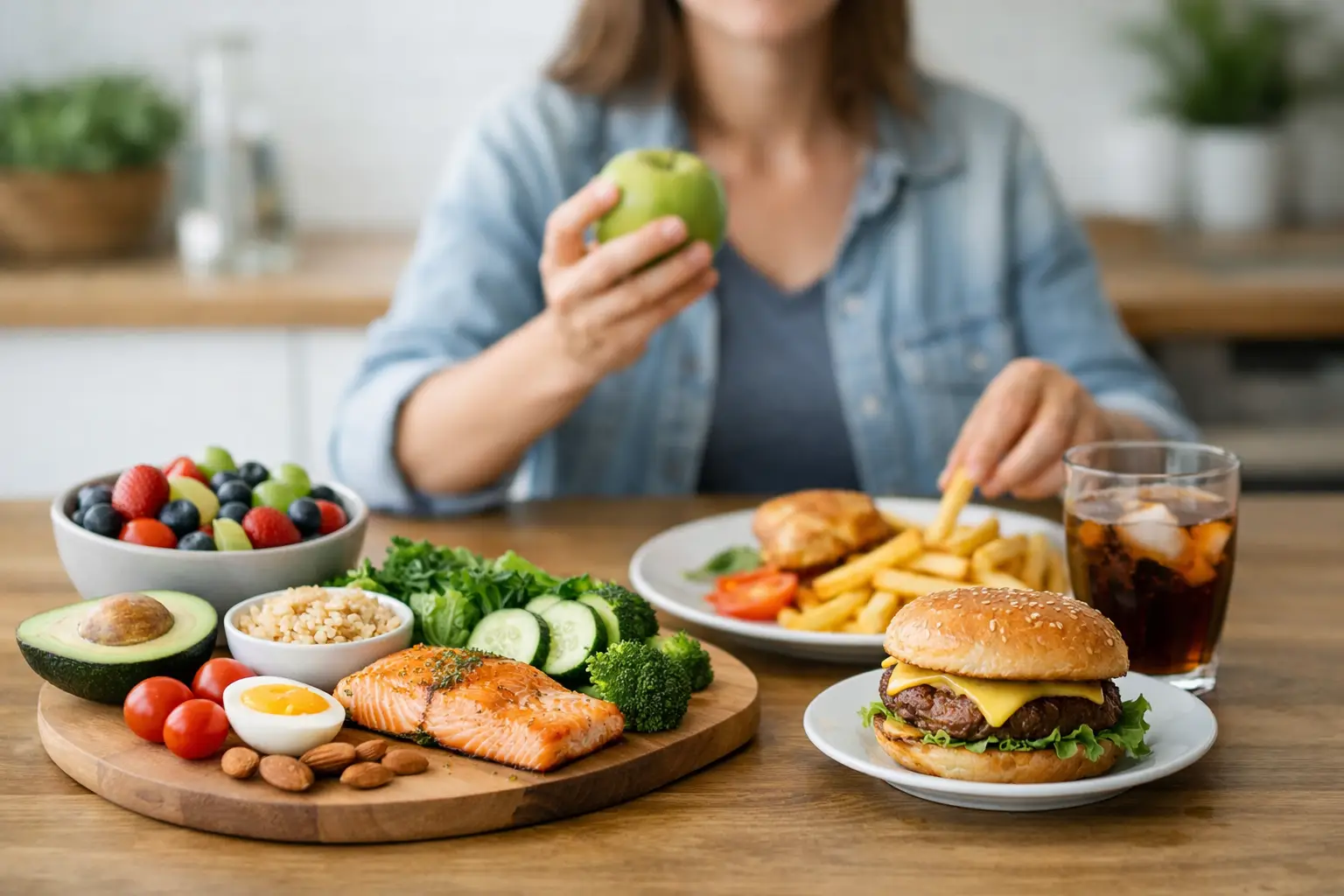
Image suggestion: A diverse group of adults, including a working parent, a young professional, and an older adult, sharing a simple balanced meal at a bright kitchen table. Show a range of genders, body types, and cultural backgrounds.
A skipped breakfast, back-to-back meetings, and a drive-thru dinner can make healthy eating feel like another job you are failing to keep up with. But nutrition basics are not a test of willpower or a reason to judge your body. They are a set of flexible skills that help you feel more energized, satisfied, and supported through the rhythms of real life.
Table of Contents
- Start with what food does for you
- Build meals that keep you satisfied
- Make room for all foods
- Use planning as support, not pressure
- Notice your body’s feedback
- A steadier way to eat
- Frequently asked questions
Start With What Food Does for You
Food is fuel, but that phrase can sound overly mechanical. Food also supports concentration during a long shift, recovery after a workout, family traditions, comfort, and connection. A useful nutrition approach makes space for all of that.
Rather than asking, “Is this food good or bad?” try asking, “What would help me feel steady for the next few hours?” Some days, the answer may be a home-cooked meal with vegetables and whole grains. Other days, it may be a sandwich between appointments or a frozen meal after a late commute. Both can fit into a healthy pattern.
Your body needs carbohydrates, protein, fats, vitamins, minerals, fiber, and fluids. You do not need to calculate every gram to benefit from them. The goal is to create meals and snacks that are filling enough, enjoyable enough, and practical enough to repeat.
Nutrition Basics: Build a Balanced Plate
A balanced meal is not a perfectly arranged plate. It is simply a meal that includes enough variety to provide lasting energy and satisfaction. When one part is missing, you may notice predictable effects: a meal low in protein might leave you hungry quickly, while a meal without carbohydrates can make an active afternoon feel harder than it needs to.
Use this flexible framework as a starting point:
- Choose a protein source. Eggs, Greek yogurt, chicken, fish, tofu, beans, lentils, cottage cheese, or lean meat can help support muscle repair and keep meals satisfying. Your needs vary with age, activity level, health conditions, and appetite, so there is no single “right” serving for everyone.
- Add a carbohydrate you enjoy. Fruit, oats, potatoes, rice, pasta, bread, corn, beans, and whole grains provide energy. Carbohydrates are especially useful around exercise, physically demanding work, and busy days when your brain needs reliable fuel.
- Include color and fiber where you can. Vegetables, fruit, beans, nuts, seeds, and whole grains help support digestion and heart health. Fresh produce is great, but frozen and canned options count too. Choose lower-sodium canned foods when available, and rinse beans or vegetables if sodium is a concern.
- Do not forget fat and flavor. Avocado, olive oil, nuts, cheese, seeds, dressings, and sauces can make food more satisfying. Flavor matters because a meal you genuinely want to eat is more likely to become a sustainable habit.
A breakfast of yogurt, berries, granola, and peanut butter checks several of these boxes. So does a rice bowl with beans, salsa, avocado, and leftover chicken. So does pasta with meat sauce, spinach, and a side of fruit. The point is not to make every meal nutritionally impressive. It is to make your overall routine more supportive.
Make Room for All Foods
Strict food rules often backfire. When you label a food “off limits,” it can take up more mental space and make eating feel loaded with guilt. That guilt is not a nutrition strategy.
Nutrient-dense foods deserve regular space because they help your body function well. At the same time, cookies at a birthday party, pizza night with your kids, or takeout after a difficult week do not erase your health. Context matters. A person managing diabetes, high blood pressure, digestive conditions, or food allergies may need more individualized guidance, but even then, shame does not improve decision-making.
Try thinking in patterns instead of isolated meals. If lunch was fast food because work ran late, your next meal does not need to be a punishment. A simple dinner with protein, produce, and a carbohydrate is enough. You are not “starting over.” You are continuing.
Use Planning as Support, Not Pressure
The best meal plan is not the most ambitious one. It is the one that still works on Wednesday night when everyone is tired and the refrigerator looks uninspiring.
Start by identifying your highest-friction moments. Maybe mornings are rushed, afternoon hunger hits before your commute, or dinner decisions create stress. Then prepare a few answers rather than mapping every bite for the week.
Keep convenient staples visible and easy to use: eggs, yogurt, fruit, bagged salad, frozen vegetables, canned beans, rotisserie chicken, whole-grain bread, tortillas, rice, soup, and nuts. Convenience foods are not a shortcut you need to apologize for. They are often what makes consistency possible.
For example, a shift worker might pack two filling snacks, such as cheese and crackers or an apple with peanut butter, to avoid reaching the point of intense hunger. A parent might cook extra rice and protein at dinner to make tomorrow’s lunch easier. Someone who travels for work might look for a protein source, a produce option, and a carbohydrate at the airport instead of waiting for a perfect choice that may not exist.
Notice Your Body’s Feedback
Nutrition advice can become noisy quickly, especially online. Your own feedback is valuable data. Notice how different meals affect your energy, digestion, mood, sleep, workout recovery, and hunger later in the day.
This is not an invitation to monitor yourself obsessively. It is a chance to become more curious. If you are ravenous every afternoon, you may need a more substantial lunch or a planned snack. If you feel sluggish during workouts, you may be under-fueling beforehand. If certain foods repeatedly cause discomfort, a registered dietitian or health care professional can help you investigate without jumping to restrictive conclusions.
Hydration belongs here, too. Water needs vary based on climate, activity, medications, and health status. A practical starting point is to drink regularly throughout the day and notice the color of your urine, aiming for pale yellow most of the time. Coffee, tea, milk, and water-rich foods also contribute to fluid intake, though water remains a reliable choice.
A Steadier Way to Eat
The strongest nutrition habits are usually quiet. They look like adding a fruit to breakfast, keeping a satisfying snack in your bag, drinking water before your second coffee, or making enough dinner for lunch tomorrow. These choices may not look dramatic on social media, but they can improve your energy and reduce the stress of deciding what to eat.
Progress also will not be perfectly linear. Travel, illness, celebrations, financial changes, caregiving, and stressful work seasons can all shift how you eat. Adaptation is a health skill. Give yourself permission to use simpler meals, ask for support, and return to the basics when life gets full.
Frequently Asked Questions
Do I need to track calories or macros?
No. Tracking can be useful for some people with specific performance goals or under professional guidance, but it is not required for better nutrition. For many people, regular meals, balanced choices, and attention to hunger and fullness are more sustainable. If tracking makes you anxious or overly focused on numbers, it may not be the right tool for you.
Is breakfast really necessary?
It depends. Some people feel and perform better after breakfast, while others prefer to eat later. What matters is whether your eating pattern provides enough energy and nutrients across the day. If you often feel shaky, distracted, or overly hungry by midmorning, experiment with something simple like toast with eggs, oatmeal with nuts, or a yogurt smoothie.
What is the easiest healthy snack?
The easiest snack is one you will actually keep nearby and enjoy. Pairing protein or fat with a carbohydrate often creates more staying power: fruit and cheese, hummus and pretzels, yogurt and granola, or nuts with a banana are all practical options.
How can I eat better without being perfect?
Choose one repeatable action that makes your day easier, such as adding protein to breakfast or packing an afternoon snack. Build from there. Your health is shaped by what you do most often, not by one meal, one number on the scale, or one difficult week.