
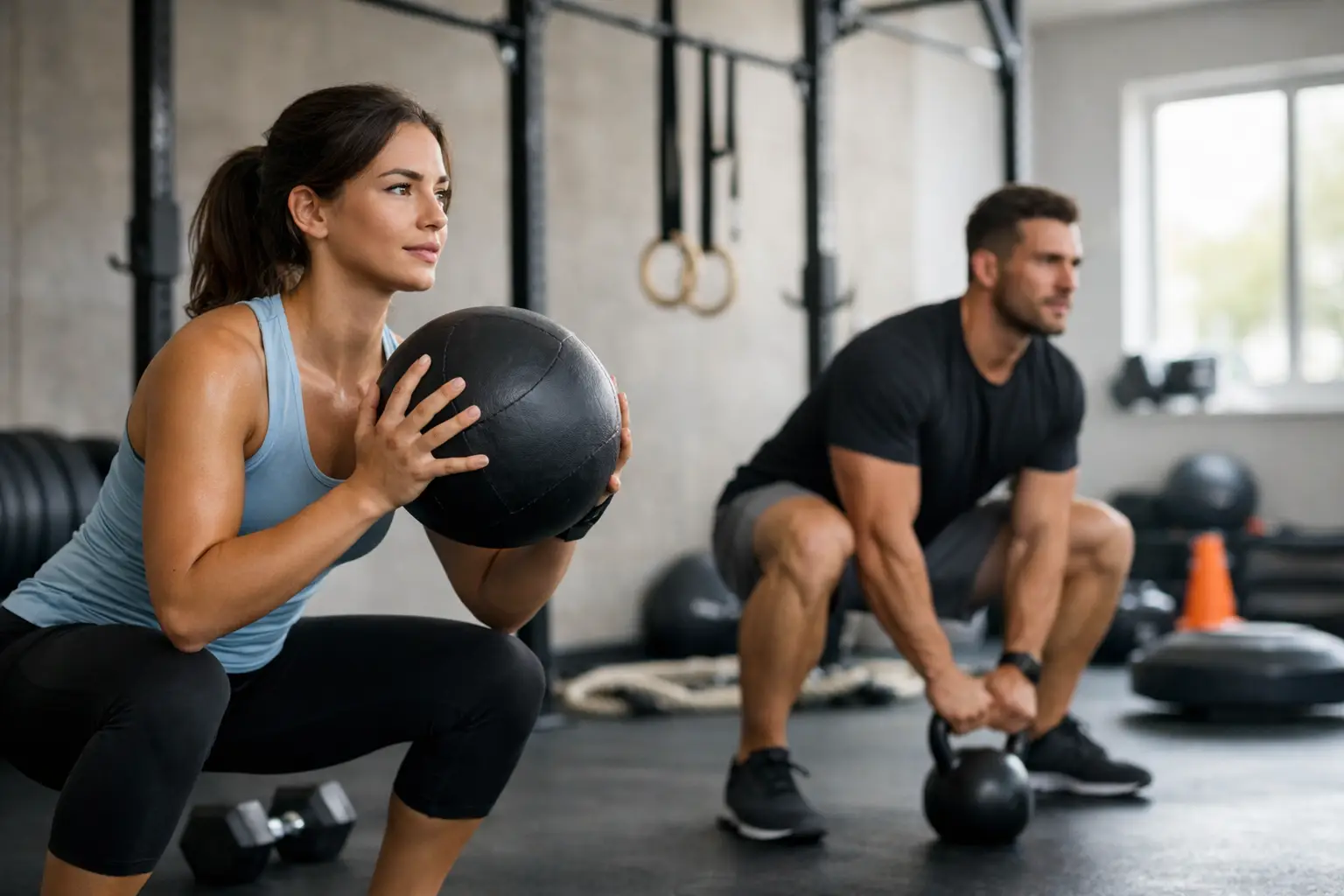
You do not need to train like an athlete to feel stronger carrying groceries, getting up from the floor, lifting a child, or making it through a long workday with less stiffness. Functional strength training for beginners focuses on those real-life demands. It is not a punishment for what your body looks like or a test of how hard you can push. It is practice for moving through your day with more confidence.
Table of Contents
- What functional strength training means
- Why beginners benefit from it
- How to start safely
- A simple beginner workout
- How to progress without overdoing it
- Frequently asked questions
What functional strength training actually means
Functional strength training builds the movement patterns people use in daily life: squatting, hinging at the hips, pushing, pulling, carrying, rotating, and resisting rotation. A workout might include a chair squat, a dumbbell deadlift, a wall push-up, a row, and a carry. None of these movements needs to look flashy to be useful.
The goal is not to make everyday life feel like a workout. The goal is to give your muscles, joints, and nervous system more capacity for the things life already asks of you. That can mean fewer aches after yardwork, more ease climbing stairs, or better confidence returning to exercise after a long break.
Traditional strength training can absolutely be functional, too. The difference is emphasis. Instead of chasing one muscle group, one number on the scale, or exhaustion at every session, you build balanced, repeatable strength around quality movement.
Why this functional strength training approach works for beginners
Many beginners assume a workout only counts if it leaves them sore, sweaty, or completely spent. That belief can make fitness feel like one more demand in an already full week. For a parent juggling schedules, a professional sitting through back-to-back meetings, or a shift worker managing unpredictable sleep, that approach often falls apart quickly.
Functional strength training gives you a more practical target: get a little stronger at foundational movements, then repeat them consistently. You can begin with body weight, a resistance band, one pair of dumbbells, or household items used carefully. The best starting plan is the one you can recover from and return to next week.
It also helps reveal useful information. If a bodyweight squat feels uncomfortable, that is not a reason to judge yourself. It is a cue to reduce the range of motion, use a chair for support, or seek guidance if pain persists. Functional strength training is partly about building strength and partly about learning how your body responds.
How to begin functional strength training safely
Start with two nonconsecutive functional strength training sessions each week. This leaves room for recovery, especially if you are new to exercise, returning after injury, managing high stress, or sleeping poorly. Sessions can be 20 to 30 minutes. More is not automatically better.
Before you begin, choose a level that lets you move with control. You should feel challenged by the final few repetitions, but not strained, breathless, or shaky in a way that makes form disappear. Sharp pain, joint pain that worsens with each rep, dizziness, chest pain, or unusual shortness of breath are reasons to stop and consult a qualified health professional.
Build around these five movement patterns
You do not need to cram every exercise into every functional strength training session, but these patterns create a useful foundation:
- Squat: Sit down and stand up from a chair, then progress to a bodyweight squat. This supports getting up from low seats, using stairs, and moving with control.
- Hinge: Practice pushing your hips back with a dowel, light dumbbells, or a backpack held close to your body. A hinge teaches you to lift from the hips rather than rounding through the lower back.
- Push: Start with wall push-ups or incline push-ups using a sturdy counter. Lower inclines are harder, so progress gradually.
- Pull: Resistance-band rows or one-arm dumbbell rows help balance pushing movements and support posture for people who spend long hours at a desk or behind the wheel.
- Carry and brace: Carry dumbbells, grocery bags, or other evenly weighted objects while walking slowly and standing tall. Carries build grip, trunk stability, and confidence under load.
A sixth pattern, step-ups or split squats, can be added once basic squats feel comfortable. These movements ask each leg to contribute more independently, which is useful for walking, stairs, and balance.
A simple full-body beginner functional strength training workout
After three to five minutes of easy movement, such as walking in place, arm circles, and gentle hip hinges, try this session. Complete two rounds at first, resting about 45 to 90 seconds between exercises as needed.
- Chair squat: 8 to 10 repetitions
- Dumbbell or backpack hip hinge: 8 to 10 repetitions
- Wall or counter push-up: 6 to 10 repetitions
- Resistance-band or dumbbell row: 8 to 10 repetitions per side
- Farmer carry: 20 to 30 seconds
Move slowly enough that you can notice what you are doing. Keep your feet grounded during squats, let your hips move back during hinges, and avoid shrugging your shoulders toward your ears during rows and carries. You do not need perfect form to begin, but you do want controlled form that improves with practice.
If you have no equipment, use a chair squat, wall push-up, towel-assisted row only if it can be anchored safely, glute bridge, and a suitcase carry with a securely closed backpack. Equipment can add options, but it is not a requirement for building a strong habit.
Progress without turning every functional strength training workout into a test
The most reliable progress is usually boring in the best way. Keep an exercise the same long enough to feel more capable at it. When you can complete all planned reps with steady form and have a few repetitions left in reserve, make one small change. Add one or two reps, use slightly more weight, choose a lower push-up incline, add another round, or carry for a few more seconds.
Change one variable at a time. Adding weight, volume, and new exercises all at once makes it harder to know what your body is responding to. It also raises the chance that a manageable workout becomes an exhausting one.
Recovery matters here. Strength improves between sessions, not only during them. Aim for regular meals with enough protein, hydration, sleep when possible, and lighter activity such as walking on rest days. If work, caregiving, illness, or stress has drained your capacity, maintaining your current routine is still a meaningful win. Your plan should bend with real life rather than breaking the moment life gets busy.
Common beginner mistakes to skip
The first is rushing to heavy weights before you understand the movement. A lighter load that you can control is productive. The second is copying a complicated social-media circuit that leaves no time to learn technique or rest. Variety can be enjoyable, but constant novelty is not required for results.
Another common trap is treating soreness as proof of success. Mild muscle soreness can happen, especially early on, but it is not the goal. A workout that leaves you unable to comfortably sit, walk, or work the next day may be more than your current recovery can support.
Finally, avoid measuring progress only through body weight or appearance. Notice practical changes: carrying bags feels easier, your knees feel more stable on stairs, you can get off the floor with less effort, or you feel less intimidated entering the gym. Those changes are worth recognizing.
A steady start beats an intense one
Functional strength training is not about becoming a different person in 30 days. It is about giving the person you already are more support for the demands, responsibilities, and activities that matter to you. Start small enough that you can keep going, make adjustments without shame, and let consistency create the confidence that motivation alone cannot.
Frequently Asked Questions
How many days per week should a beginner do functional strength training?
Two days per week is an effective place to start. After several weeks, you may choose to add a third session if you are recovering well and your schedule allows. Walking, mobility work, and everyday activity can fit between strength sessions.
Is functional strength training good for weight loss?
It can support weight-management goals by building muscle, improving daily activity tolerance, and helping create a sustainable routine. Still, weight change depends on many factors, including nutrition, sleep, stress, medications, and health conditions. Strength training remains valuable even when the scale does not move quickly.
Should beginners use machines, free weights, or body weight?
Any of these can work. Machines can feel stable and approachable, bodyweight movements are convenient, and free weights can train coordination. Choose the option that feels safe, accessible, and easy to repeat. If you are unsure how to use equipment, ask a qualified trainer for a brief orientation.
What if I feel embarrassed starting at the gym?
Most people are focused on their own workout, and every experienced exerciser once had a first day. Begin with a short plan, use a quieter area if available, and remember that learning is the purpose of being there. Showing up for a manageable session is a strong first step.
For more on functional strength training, consider reading Dumbbell Workout Handbook: Strength and Power: 100 Best Workouts for Building Muscle and Maximizing Gains by Michael Volkmar.