
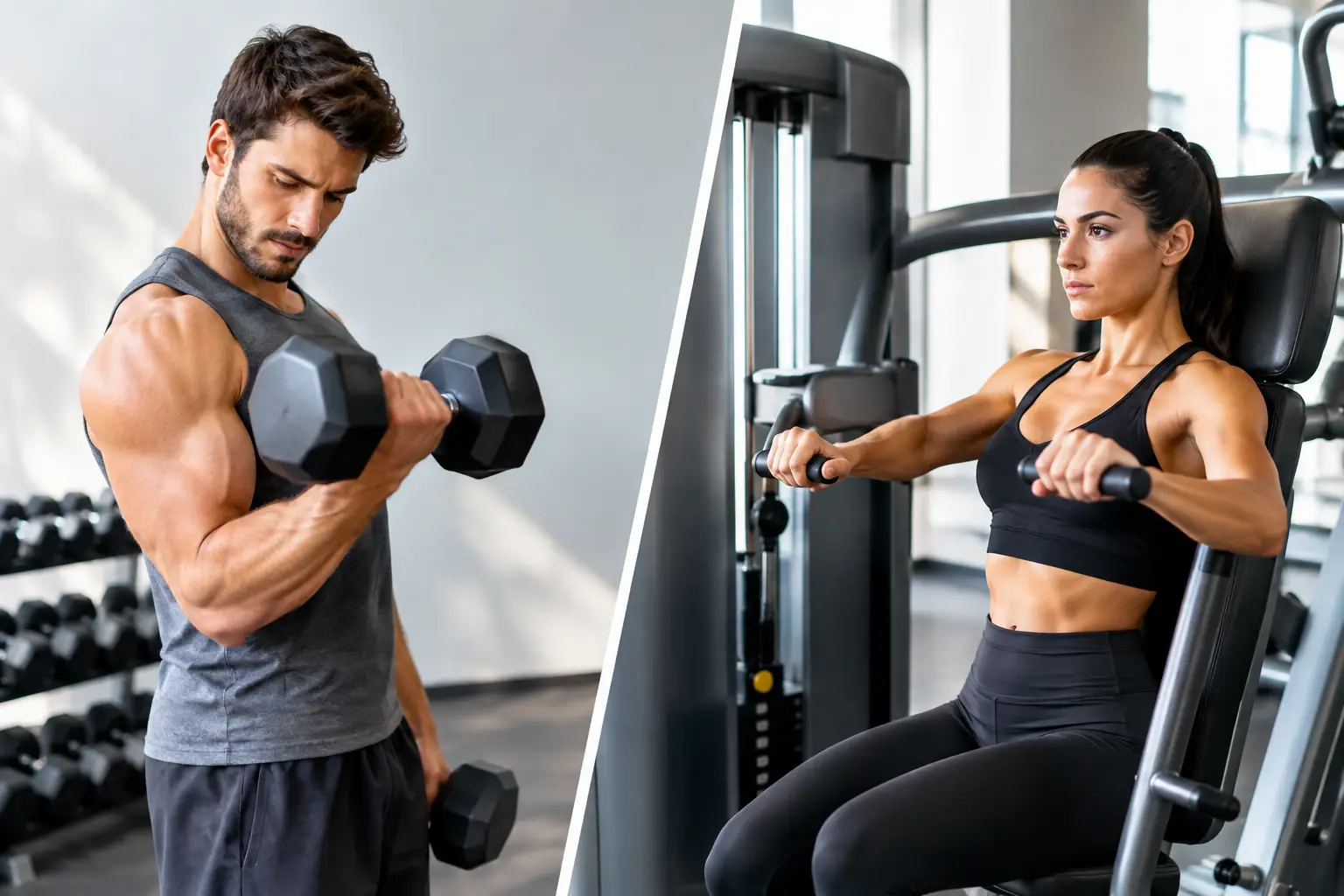
A crowded gym can make a simple workout feel like a decision test: Should you head for the dumbbells, wait for the cable station, or use the machines that already show you where to sit? In the free weights versus machines debate, the best answer is rarely the one that looks most impressive. It is the option you can perform safely, progress with consistently, and fit into your actual life.
Table of Contents
- What free weights and machines each do well
- Free weights versus machines for different goals
- How to choose the right option for your workout
- How to use both without overcomplicating training
- Frequently asked questions
What free weights and machines each do well
Free weights include dumbbells, barbells, kettlebells, and weight plates. Because the weight is not attached to a fixed path, you control the movement from start to finish. A dumbbell press, goblet squat, or deadlift asks your body to coordinate multiple joints and muscles at once. That can build strength, balance, body awareness, and confidence with everyday movements like lifting a suitcase or getting up from the floor.
Machines guide the weight along a set path. Think of a leg press, chest press, lat pulldown, or seated row. That structure can make it easier to focus on the working muscle without also worrying as much about balance, setup, or keeping the weight steady. For someone new to strength training, returning after an injury, or exercising after a demanding workday, that reduced complexity can be a real advantage.
Neither category is automatically safer or more effective. A machine can be poorly adjusted, loaded too heavily, or used with rushed form. Free weights can be extremely safe when the load, range of motion, and exercise choice match your current ability. The meaningful question is not which tool wins. It is what you need from the tool today.
Why free weights can be valuable
Free weights allow more freedom in how you move. This matters because bodies are not identical. You may find that a slight change in hand position during a dumbbell press feels better on your shoulders, or that holding a kettlebell during a squat helps you stay upright.
They also make small, practical movements possible. You can carry dumbbells, do split squats, perform rows with one arm at a time, and train in multiple directions. Those patterns can expose side-to-side differences and build control that transfers well beyond the gym.
The trade-off is that free weights require more attention. If you are learning a new lift, fatigue can make technique unravel before the target muscles have done enough work. Starting light is not a lack of ambition. It is how you give your nervous system time to learn the movement.
Why machines can be valuable
Machines make strength training more accessible. You can often adjust a pin, set the seat, and begin. That simplicity helps when you have 25 minutes between meetings, are working around a minor limitation, or want to train hard without spending energy on complicated setup.
They can also be useful for adding training volume. After squats or lunges, a leg extension or hamstring curl lets you challenge the legs without needing to stabilize a barbell. A chest-supported row can train your back while giving your lower back a break.
The limitation is fit. A machine’s handles, seat height, and range of motion may not suit every body. If you feel pinching, sharp pain, numbness, or joint discomfort that does not improve after adjusting the setup, choose another exercise. You do not need to force your body to match a machine.
Free weights versus machines for different goals
If your goal is general strength and long-term health, both work. Research and real-world training experience point to the same basic principle: muscles respond to enough challenge over time. Progressive overload, good technique, recovery, and consistency matter more than whether resistance comes from a barbell or a weight stack.
For building muscle, machines are often underrated. They can help you take a set close to fatigue with less concern about balance, particularly for moves such as leg curls, chest presses, and cable rows. Free weights are equally effective when you can control them well, and they give you plenty of options for compound movements that train several areas at once.
For learning movement skills, free weights have an edge. A light goblet squat can teach bracing and squat mechanics. Dumbbell rows can help you feel how your shoulder blade moves. Still, a machine can be the better first step if it helps you develop strength without feeling overwhelmed.
For injury recovery or joint sensitivity, the answer depends on the person and the condition. A fixed path may feel more stable, while free weights may allow a more comfortable range of motion. Work with a qualified clinician or physical therapist for pain, a recent injury, or a medical condition that changes how you exercise.
For busy adults, the winner is often the equipment that is available. A well-designed 30-minute session using familiar machines beats a theoretically perfect barbell plan you never have time or confidence to do. At home, a pair of adjustable dumbbells may offer more value than trying to recreate a full gym.
How to choose the right option for your workout
Use this four-step filter instead of treating every workout like a test of fitness knowledge.
- Start with your comfort and skill level. Choose movements you can perform with steady control and normal muscle effort, not panic or joint pain. If you are new, machines can help you establish a routine. Add simple dumbbell exercises as your confidence grows.
- Match the tool to the movement. Free weights are often useful for squats, hinges, carries, presses, and rows. Machines are excellent for targeted work such as leg curls, calf raises, chest presses, and pulldowns. There is no rule that says a workout has to use only one category.
- Consider your energy that day. After poor sleep, a long shift, or a stressful week, a machine circuit may be the sensible choice. On a day when you feel rested and focused, you may enjoy practicing a more technical free-weight movement. Adjusting is not quitting. It is self-awareness.
- Track progress in a simple way. Record the weight, repetitions, and how the set felt. When you can complete your planned reps with solid form, add a small amount of weight, an extra repetition, or another set. Strength grows from repeatable progress, not from constantly changing exercises.
A practical way to use both
For most people, a mixed approach is the sweet spot. Begin with one or two free-weight movements that build useful skills, then use machines to add volume safely and efficiently. For example, you might do goblet squats and dumbbell rows, followed by a leg curl, chest press, and cable pulldown.
If you are brand-new to resistance training, beginning with mostly machines is completely valid. Learn how to adjust the seat, select a manageable weight, and move through a comfortable range. Once that feels familiar, add one free-weight exercise at a time. A dumbbell deadlift from an elevated position or a supported dumbbell row can be a less intimidating entry point than jumping straight into a barbell routine.
If you are experienced, machines can still earn a place in your plan. They are not a beginner-only option or a shortcut. They are equipment, and smart training means using the equipment that helps you train the intended muscles with enough effort and appropriate recovery.
A practical takeaway
Free weights build coordination and give you flexible, functional movement options. Machines offer stability, convenience, and a straightforward way to challenge specific muscles. Your body does not care whether a productive set came from a sleek machine or a scratched-up dumbbell. It responds to thoughtful effort, enough recovery, and a plan you can keep returning to.
Frequently Asked Questions
Are free weights better than machines for beginners?
Not always. Machines can help beginners learn how hard resistance training should feel while reducing the balance and coordination demands of an exercise. Free weights are also appropriate when the movement is simple, the load is light, and the person has clear instruction. Many beginners do well with a combination of both.
Do machines build real strength?
Yes. Machines can build muscle and strength when you use a challenging load, practice good form, and gradually progress. If you need strength for a specific free-weight lift or sport, you will also need to practice that particular skill, but machines remain valuable supporting work.
Can I lose weight using only machines?
Yes. Weight change is influenced by many factors, including food intake, daily movement, sleep, stress, and exercise consistency. Machine workouts can improve strength and help you stay active. Focus on sustainable habits rather than using the scale as the only measure of progress.
How often should I strength train?
For many adults, two to three full-body strength sessions per week is a useful starting point. Leave time for recovery, especially when beginning. A plan you can do consistently around work, caregiving, and sleep is more valuable than an intense schedule that leaves you depleted.
The best equipment is the equipment that helps you feel capable enough to come back next week. Build from there, one well-chosen set at a time.