
A Complete Beginner’s Guide to Moving Better and Feeling Better
Walk into most gyms, and you’ll find a few foam rollers tucked into a corner. For some gyms they’ve achieved a prominent location in a central location for ease of access. Some people swear by them. Others walk right past. And if you’ve ever actually tried one, you know that “why does this feel so terrible?” face — which honestly can be part of the overall experience.Rest assured, when done properly it’s an important part of improving your overall health.
Here’s the thing: foam rolling actually works, but most people are doing it wrong. They’re rolling too fast, skipping the spots that matter, and wondering why nothing feels different. Moreover placing the roller in the wrong spots such as the “spaces” behind the neck, lower back, and knee, can do more harm then good.
Done with a little, informed intention, rolling can be one of the most useful things you add to your routine — no gym membership required, no trainer needed (but we love trainers 😉), and it takes a few minutes a day.
Foam rolling can also provide insight into overuse and dehydrated tissues. Properly hydrating is actually one of the best strategies to move better by maintaining supple and pliable connective issue.
This guide covers what foam rolling actually does, how to do it well, and where to start.
What Foam Rolling Actually Does
Foam rolling is a form of self-myofascial release, which sounds complicated, but it really just means you’re using pressure to work out tension in your muscles and hydrating by the connective tissue wrapped around them (called fascia) by pushing fluid through the body.
Fascia runs throughout your entire body. When it gets restricted — from working out, sitting too long, stress, or just moving the same way every day — it limits how well the body’s structures can do their jobs. Your joints get stiff, your range of motion decreases, and your body starts compensating in ways that eventually lead to pain movement patterns.
Foam rolling addresses that by applying slow, targeted pressure to restricted areas. Over time, consistent rolling can:
- Reduce muscle tightness and soreness
- Improve flexibility and range of motion
- Boost circulation to working muscles
- Help you recover faster between sessions
It won’t replace sleep or consistent daily exercises — but as a low-effort addition to your routine, it genuinely delivers.
Why Slow Pressure Works
Research consistently shows that foam rolling improves range of motion in the short term — without the performance dip that sometimes comes with static stretching. The leading explanation is that sustained pressure activates sensory receptors in the tissue, which signal the nervous system to relax tone. Basically, it tells the body it’s safe to let go.
Rolling increases systemic fluid flow and helps clear metabolic waste that builds up during exercise, which is why a lot of athletes roll after training, not just before.
The key phrase in all of this: sustained pressure. Fast rolling doesn’t give the nervous system or the tissue enough time to respond. Slow, intentional work does.
The Most Common Mistakes
People roll too fast. They zip back and forth across a muscle in ten seconds, check the box, and move on. Then they wonder why they’re not noticing any difference.
Think of it this way: you’re not trying to massage a muscle into submission. You’re applying deliberate pressure and giving the tissue time to respond. A good guideline is about one inch per second. When you hit a spot that feels tight or tender, that’s your cue to pause — not speed through it.
How to Foam Roll Effectively
1. Move slowly and with control.
Position yourself on the roller and move at a pace where you can actually feel what’s happening. Let your bodyweight do the work — don’t force it.
2. Find and hold tender spots.
As you roll through a muscle, you’ll find areas that feel noticeably tighter or more sensitive. When you hit one, hold for 15 to 30 seconds. You’ll usually feel the intensity shift from sharp to something softer — that’s the tissue releasing.
3. Breathe.
This sounds basic, but it matters. When you hit a tender spot, your instinct is to hold your breath. Don’t. Take a slow inhale through your nose and a long exhale through your mouth. The exhale is what tells your nervous system it’s okay to relax.
4. Stay on muscle tissue.
Rolling is for muscles — not joints or bones. Avoid direct pressure on your knees, elbows, or lower spine. The lower back is a big one: a lot of people roll directly over their lumbar vertebrae, which can make things worse. Instead, target the muscles around it — glutes, hip flexors, and upper back.
5. Keep sessions short.
Five to eight minutes of focused rolling beats twenty minutes of half-hearted effort every time. Pick two or three areas relevant to your workout and give them your full attention.
Where to Focus
1. Upper Back (Thoracic Spine)
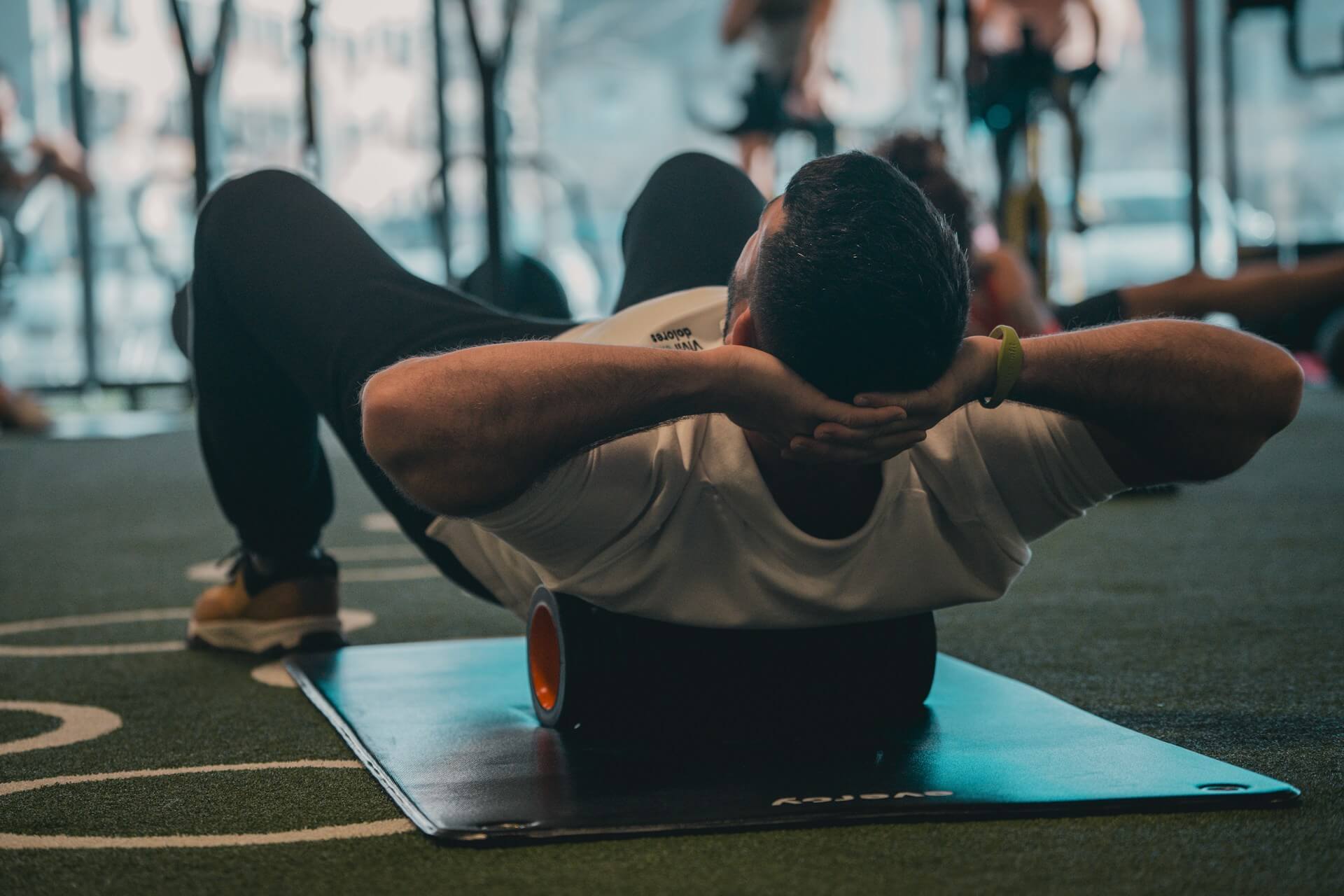
If you sit for work, this area is probably tighter than you think. Stiffness here affects your shoulder mobility and posture. Place the roller horizontally across your mid-to-upper back, support your head, and gently extend over it. Hold, breathe, then shift slightly and repeat. Stay above the lower ribs.
2. Lats
The muscles running from your armpit down to your mid-back play a big role in shoulder health. Tight lats limit overhead mobility and can contribute to shoulder pain over time. Lie slightly on your side with the roller just below your armpit and work down toward your mid-back.
3. Glutes and Hips
A common problem area for runners, cyclists, and anyone who sits all day. Tension here often radiates into the lower back. Sit on the roller, cross one ankle over the opposite knee, lean slightly into the hip of the crossed leg, and roll slowly through the glute.
4. Quads
Your quads take a beating during any lower-body training. Rolling them before a leg session can improve range of motion and reduce knee discomfort. Lie face down with the roller just above the knee and slowly work toward the hip.
A Few Safety Notes
Foam rolling is safe for most people, but a few things are worth knowing. If you have joint pain or arthritis, roll the muscles around the joint, not directly over it. If you’re hypermobile, go lighter — the goal is stability, not more range of motion. If you’re dealing with an active injury, skip the affected area and work on the surrounding muscles instead.
A helpful rule of thumb: on a scale of 0 to 10, aim to stay around a 5 or 6. Meaningful pressure, maybe mild discomfort — but never sharp pain, tingling, or numbness. If you feel any of those, ease off immediately.
When to Roll
Before training is generally the best time. A quick rolling session focused on tight areas, followed by some dynamic movement, gets your body ready to move better. After training works well too — slightly slower and more relaxed, more like a cool-down that helps your nervous system shift out of high gear.
The truth? The timing matters less than the consistency. Rolling occasionally won’t move the needle. Rolling regularly — even just five minutes a day — adds up in ways you’ll actually notice in how you move and how you feel.
A Simple Starting Routine
If you’re new to this, here’s a straightforward 5–8 minute sequence to get you started:
- Thoracic spine — 60 to 90 seconds, mid-back to upper back
- Lats — 45 to 60 seconds per side
- Glutes — 45 to 60 seconds per side
- Quads — 60 seconds per leg
Move slowly through each area, pause on anything that feels tight, and breathe. That’s it!
Final Thoughts
Foam rolling isn’t a magic fix, and it’s not a substitute for real recovery, good training, or professional care when something’s wrong. But as a consistent, low-cost habit? It genuinely works — better movement, less tension, faster recovery, and a clearer read on how your body feels day to day.
The people who get the most out of it aren’t the ones pressing the hardest or going the longest. They’re the ones who show up regularly, move slowly and with intention, and actually pay attention to what their body is telling them. Start there, and the rest follows.

WILLIAM SMITH, MS, NSCA, CSCS, MEPD, completed his B.S. in exercise science at Western Michigan University followed by a master’s degree in education and a post-graduate program at Rutgers University. In 1993, Will began coaching triathletes and working with athletes and post-rehab clientele. Will has advanced specialty certifications in cancer, post-rehab exercise and athletic development. He is the author of Exercises for Better Balance, Exercises for Parkinson’s Disease, and many other health-related books.