
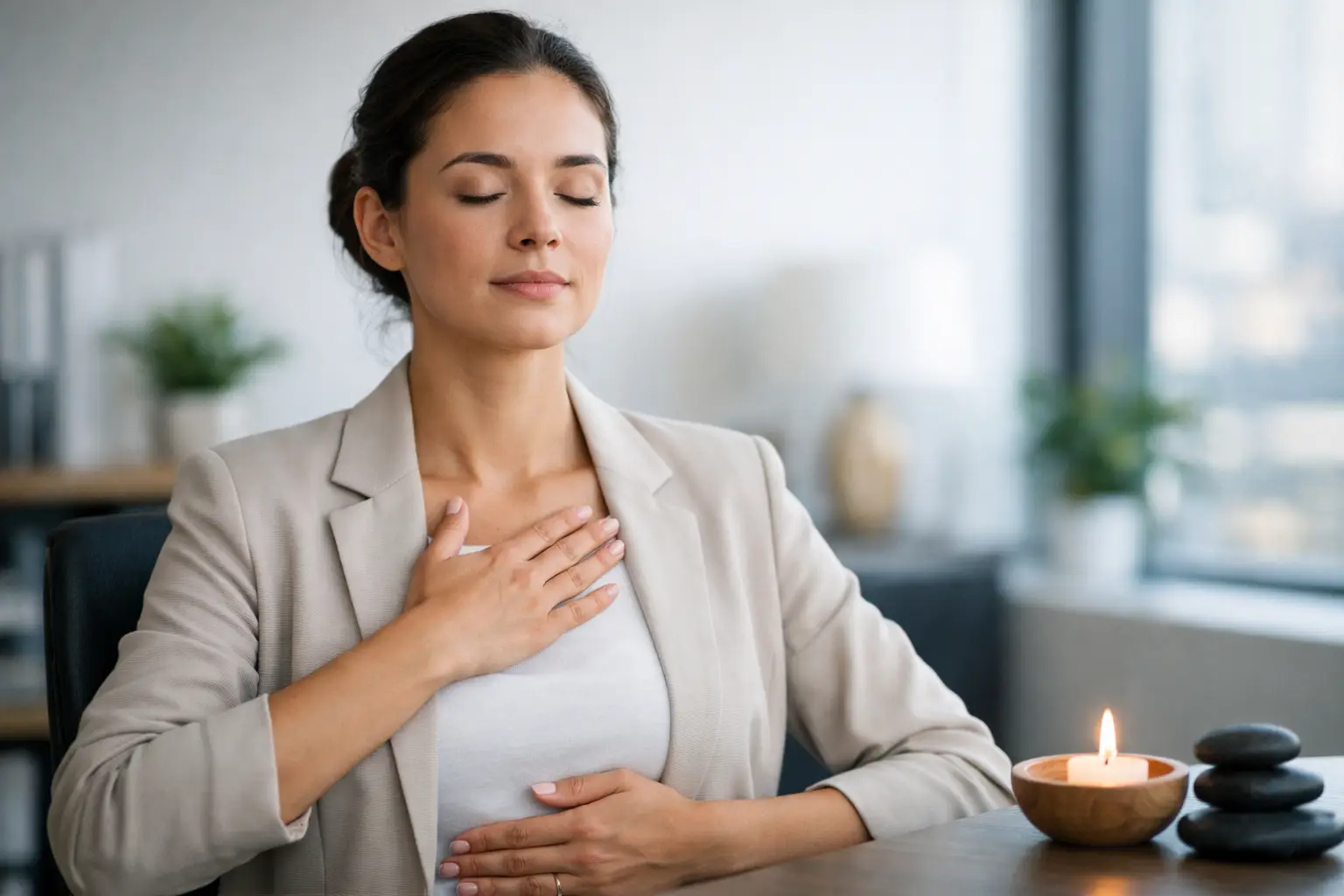
The meeting is running late, your phone keeps lighting up, and your shoulders are somewhere near your ears. You may not be able to change the demands of the moment, but breathing exercises for stress relief can give your body a clear signal: you are safe enough to soften, slow down, and think again.
This is not about forcing yourself to feel calm or doing breathing “perfectly.” It is about using a tool you already carry with you to create a little more space between stress and your next response.
Table of Contents
- Why your breathing changes under stress
- 7 breathing exercises for stress relief
- How to choose the right exercise
- When breathing techniques feel uncomfortable
- Frequently asked questions
Why your breathing changes under stress
Stress affects more than your thoughts. When your nervous system detects pressure, conflict, uncertainty, or overload, your breath often becomes faster, shallower, or more held. That response can be useful when you need to act quickly. But when it stays switched on through a packed workday, a difficult commute, parenting demands, or a restless night, it can leave you feeling wired and depleted.
A slower, more intentional breath – especially one with a comfortable, slightly longer exhale – can support the part of your nervous system associated with rest and recovery. It will not erase a deadline or solve a relationship problem. What it can do is lower the volume enough to help you make a steadier choice: take a walk, send a clearer message, eat lunch, or stop scrolling when you are already exhausted.
The best practice is the one you can use consistently without feeling strained. If counting makes you more anxious, skip the numbers. If holding your breath feels unpleasant, choose a continuous pattern instead.
7 breathing exercises for stress relief
Try one exercise at a time for one to three minutes. A hand on your belly or lower ribs can help you notice movement, but it is optional. Sit, stand, or lie down in a position that does not require you to brace or perform.
1. The longer-exhale reset
Breathe in gently through your nose for a count of three or four. Then breathe out slowly for a count of five or six. Keep the inhale easy rather than trying to take a huge breath.
Repeat for five to 10 rounds. This is a practical choice before a presentation, after an upsetting email, or when you notice yourself rushing from task to task. The point is not to empty your lungs completely. Let the exhale be smooth and unforced.
2. Box breathing
Inhale for four counts, hold for four, exhale for four, and hold again for four. Repeat for four rounds, adjusting to a count of three if four feels too long.
Box breathing gives your attention a simple job, which can be helpful when your mind is looping. It is popular in high-pressure professions for a reason: the structure is easy to remember. Still, breath holds are not for everyone. If they create tension, remove the holds and simply inhale for four and exhale for four or five.
3. Physiological sighs
Take a normal inhale through your nose, then add a second short inhale to top it off. Release one long, relaxed exhale through your mouth. Do this one to three times, then return to normal breathing.
This can be a fast reset when you feel a surge of frustration or panic building. More is not necessarily better. Repeating it too many times may make some people lightheaded, so keep it brief and gentle.
4. Belly breathing
Place one hand on your chest and one on your abdomen. Breathe in without forcing it, allowing your lower hand to rise slightly. Breathe out slowly and feel it lower. Your chest may still move a little. That is completely normal.
Practice for two minutes while waiting for coffee, sitting in the car before heading inside, or winding down after work. Belly breathing is less about making your stomach expand dramatically and more about letting your diaphragm do its natural job.
5. Coherent breathing
Choose an even, comfortable rhythm: inhale for five counts and exhale for five counts. Continue for three to five minutes.
This steady pattern works well as a daily practice because it is simple and not overly intense. Try it before bed, after exercise, or during a midday break when you need to transition from doing mode into recovery mode. If five counts feel too slow, use four in and four out.
6. Alternate-nostril breathing
With clean hands, gently close your right nostril and inhale through the left. Close the left nostril, release the right, and exhale through the right. Inhale through the right, switch, and exhale through the left. That is one round.
Complete three to five slow rounds. Some people find this pattern grounding because it requires focused attention and a slower pace. Skip it if you are congested, uncomfortable with the hand position, or simply do not enjoy it. A stress-relief practice does not need to be complicated to count.
7. The “notice and name” breath
Breathe normally and quietly. On each exhale, name what you notice in a neutral way: “tight jaw,” “warm hands,” “racing thoughts,” or “heavy shoulders.” Do this for one minute.
This option is useful when structured breathing feels like another task on your list. Naming sensations can interrupt the habit of judging yourself for being stressed. You are not failing at calm. You are noticing what is here and giving yourself a moment to respond with care.
How to choose the right exercise
Match the technique to the moment, not to an ideal routine. Need a quick reset between meetings? Use one or two physiological sighs or five longer exhales. Feeling mentally scattered at your desk? Box breathing or alternate-nostril breathing may give your attention an anchor. Trying to settle before sleep? Coherent breathing or belly breathing is usually a gentler fit.
Consistency matters more than duration. One minute before you open your inbox can be more useful than a 20-minute practice you only do when life is unusually calm. Consider pairing breathwork with an existing cue: after you park, before dinner, following your workout cooldown, or when you put your phone on the charger.
You can also combine it with movement. A slow walk with an easy inhale for three steps and exhale for four steps may feel more natural than sitting still, especially if you have spent most of the day indoors or at a screen.
When breathing techniques feel uncomfortable
Not everyone experiences slow breathing as relaxing right away. If you have panic symptoms, a history of trauma, respiratory conditions, or dizziness, certain techniques can feel activating. That does not mean stress relief is out of reach. It means a different approach may be kinder.
Start with normal breathing and focus on your environment instead: feel your feet on the floor, look for five neutral objects in the room, or take a brief walk. Avoid deep, forceful breaths and long breath holds. If anxiety, shortness of breath, chest pain, or dizziness is frequent or severe, talk with a qualified health professional rather than trying to breathe through it alone.
Frequently Asked Questions
How long should I do breathing exercises for stress relief?
Start with one to three minutes. Even five slow breaths can shift how you feel in the moment. As the practice becomes familiar, you may prefer five to 10 minutes, but longer is not automatically better.
Should I breathe through my nose or mouth?
For most relaxed practices, breathing in and out through the nose is comfortable and convenient. A mouth exhale can be useful for a longer-exhale reset or physiological sigh. Choose what feels natural and does not leave you gasping or tense.
Can breathing exercises replace therapy or medical care?
No. They are a useful self-regulation tool, not a replacement for mental health treatment or medical evaluation. Stress that is persistent, overwhelming, or affecting daily life deserves real support.
What if I forget to practice?
That is normal. Do not turn a missed day into another reason to criticize yourself. Take one unhurried breath now, let the exhale lengthen slightly, and return to the next moment with a little more room to choose what you need.
For more on stress and ways to cope with stress, read Resilience: How We Find New Strength At Times of Stress.