
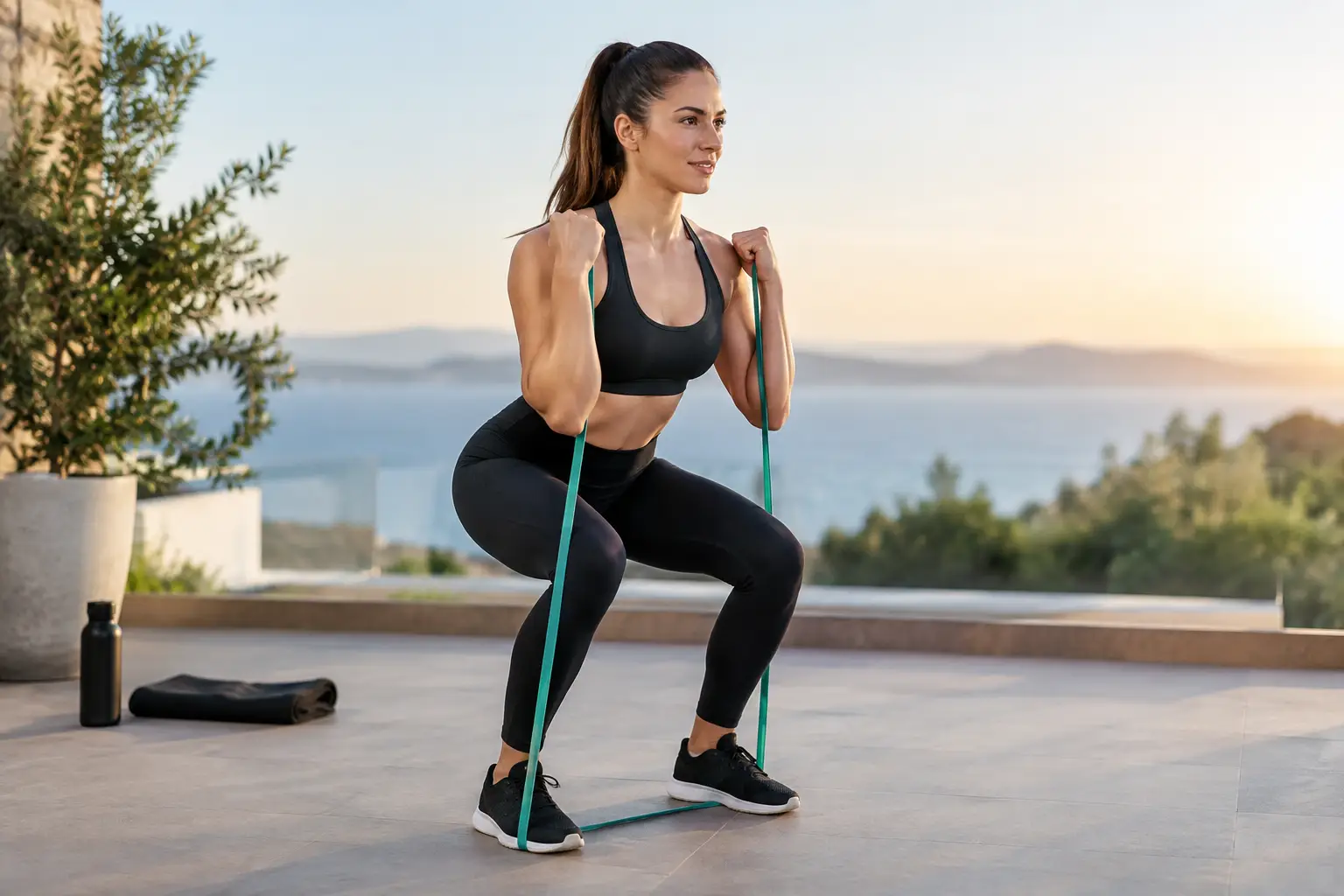
A resistance band can live in a desk drawer, suitcase, or living-room corner and still give you a meaningful strength session. That matters when a long commute, a sick child, shift work, or plain old exhaustion makes the gym feel out of reach. This resistance band training guide will help you choose bands, use them safely, and build a routine that supports your life instead of demanding that your life bend around it.
Table of Contents
- Why bands work
- Choose the right resistance and setup
- Learn the core movement rules
- Build your full-body band workout
- Progress without pushing into burnout
- Common mistakes and simple fixes
- Frequently asked questions
1. Why resistance bands work
Bands create tension differently from dumbbells. With a weight, the load stays the same throughout a movement. With most bands, tension increases as the band stretches. That can make the end range of movements such as rows, presses, and squats feel especially challenging.
They are not a lesser option for people who cannot get to a gym. Bands can build strength, improve joint control, and make mobility work more purposeful. They are particularly useful for learning movement patterns, returning after time away from exercise, or fitting in a 15-minute session when your capacity is low.
There are trade-offs. A heavy barbell may be a better tool for someone whose specific goal is maximizing absolute strength. Bands also require more attention to setup because an insecure anchor can snap back unexpectedly. But for consistent, whole-body training in a small space, their convenience is hard to beat.
2. Choose the right resistance and setup
Start with a small range of loop bands or tube bands with handles: light, medium, and heavy. The color system is not universal, so do not assume a blue band from one company feels like a blue band from another. What matters is whether you can perform your planned repetitions with steady form and still feel you could do one or two more.
For lower-body movements, many adults eventually need a medium or heavy band. For shoulder work and smaller muscles, a light band is often plenty. If you are brand-new, recovering from injury, pregnant, or managing persistent pain, lighter resistance and professional guidance can be the wiser starting point.
Before every workout, inspect your band for cracks, thinning, tears, or brittle spots. Replace damaged bands. If you anchor a band to a door, use an anchor designed for that purpose, close the door fully, and position yourself so it opens away from you. Never attach a band to unstable furniture, a sharp edge, or something you have not tested.
3. Learn the core movement rules
Good band training is less about chasing a dramatic burn and more about creating controlled tension. Start each repetition slowly. Set your ribs over your pelvis, keep your feet grounded, and exhale during the effort. Your shoulders should not creep toward your ears during rows, presses, or arm work.
Use a range of motion that feels controlled and pain-free. Muscle effort, warmth, and temporary fatigue are normal. Sharp pain, numbness, joint pinching, dizziness, or a feeling that something is wrong are reasons to stop. You do not earn progress by ignoring signals from your body.
Keep the band under tension without letting it yank you back to the starting position. On a row, for example, pull your elbows back with control, pause briefly, then return slowly. That return phase matters. It builds control and helps you notice when the resistance is too heavy.
4. Build your full-body band workout
For most busy adults, two or three full-body sessions a week is enough to create momentum. Leave at least a day between sessions when possible. If your week is chaotic, one session still counts. The goal is a practice you can return to, not a streak you fear breaking.
Begin with five minutes of easy movement: walk around your home, march in place, circle your arms, and do a few bodyweight squats to a comfortable depth. Then choose one exercise from each pattern below. Complete two or three rounds of 8 to 15 repetitions, resting 45 to 90 seconds as needed.
Squat: Banded squat
Stand on the middle of a long band with feet about hip-width apart. Hold the ends near shoulder height, then sit down and back as though lowering into a chair. Press through your whole foot to stand. If your knees are sensitive, shorten the range and use a chair behind you as a target.
Hinge: Banded Romanian deadlift
Stand on the band and hold its ends with your arms long. Soften your knees, send your hips backward, and keep your spine long as your torso tips forward. Stand by squeezing your glutes. You should feel your hamstrings working, not strain in your low back.
Pull: Standing band row
Anchor the band at about chest height. Step back until there is gentle tension, then pull your elbows toward your ribs. Pause when your shoulder blades draw back naturally. Avoid twisting or leaning your whole body backward to make the repetition happen.
Push: Band chest press
Anchor the band behind you at chest height. Face away from the anchor, hold the handles or ends, and press forward until your arms are nearly straight. Keep a staggered stance if you need more balance. If a behind-the-body setup feels uncomfortable in your shoulders, perform a standing wall push-up instead.
Carry and core: Pallof press
Anchor the band at chest height beside you. Stand sideways to the anchor and hold the band with both hands at your sternum. Press your hands straight out, resisting the band’s pull to rotate you. Return slowly, then switch sides. This quiet-looking exercise trains your trunk to stabilize during everyday tasks, from carrying groceries to lifting a child.
Finish with one set of 12 to 20 band pull-aparts or glute bridges if they feel good. This is an optional add-on, not a requirement. A short workout completed with care is more useful than a perfect program abandoned after a demanding week.
5. Progress without pushing into burnout
Progress can mean more than using a thicker band. First, make your current reps smoother. Then add a few repetitions, another set, or a slightly slower lowering phase. You can also step farther from the anchor point or shorten the band to increase tension.
Use a simple effort check: end most sets feeling like you could complete one or two additional good repetitions. This is often called leaving reps in reserve. It helps you train hard enough to adapt without turning every session into a test of willpower.
On high-stress weeks, reduce your workout to one or two rounds, use lighter bands, or focus on a walk and a few mobility movements. Stress, sleep, caregiving, and emotional recovery all affect training capacity. Adjusting is not quitting. It is how sustainable training works.
6. Common mistakes and simple fixes
The most common mistake is choosing too much resistance too soon. When the band is so heavy that you hold your breath, shrug your shoulders, or rush the movement, reduce tension. Better mechanics make strength gains more likely and irritation less likely.
Another issue is using a band that begins completely slack. You want mild tension at the start of most exercises, then increasing resistance through the movement. Take a small step away from the anchor or adjust your grip before adding a heavier band.
Finally, do not judge the workout only by sweat, soreness, or calories. A band session can be effective even if it leaves you feeling more capable rather than flattened. Track practical wins: carrying bags with less discomfort, rising from the floor more easily, or feeling steadier during a long workday.
A stronger routine can be small
Your body does not need punishment to become stronger. It needs an appropriate challenge, enough recovery, and a plan that survives real life. Put your bands where you can see them, choose two movements for your next available 10 minutes, and let that be a valid beginning.
Frequently Asked Questions
Can resistance bands build muscle?
Yes. Bands can support muscle growth when the resistance is challenging, your technique is controlled, and you gradually increase the training demand over time. As you become stronger, use heavier bands, more repetitions, more sets, or a slower tempo.
How often should I train with resistance bands?
Two to three full-body sessions per week works well for many people. If you are starting from zero, begin with one or two sessions. Consistency matters more than copying an aggressive schedule that does not fit your recovery or responsibilities.
Are resistance bands safe for beginners?
They can be very beginner-friendly when used with light resistance and secure anchors. Inspect bands before use, move slowly, and avoid painful ranges. If you have a recent injury, surgery, or a medical condition that affects exercise, ask a qualified clinician or physical therapist for individualized advice.
What band resistance should I use?
Choose a band that makes the final few repetitions feel challenging while your form stays steady. For many exercises, you should finish with the sense that one or two more quality reps were possible. Lighter bands are often best for shoulders; legs and back may need more resistance.
Can I use bands every day?
You can do light mobility and activation work daily if it feels good. For harder strength sessions involving the same muscle groups, most people benefit from recovery between workouts. Pay attention to lingering soreness, poor sleep, or unusually low energy, and scale back when needed.
The best plan is the one that leaves room for your work, relationships, recovery, and tomorrow’s effort.