
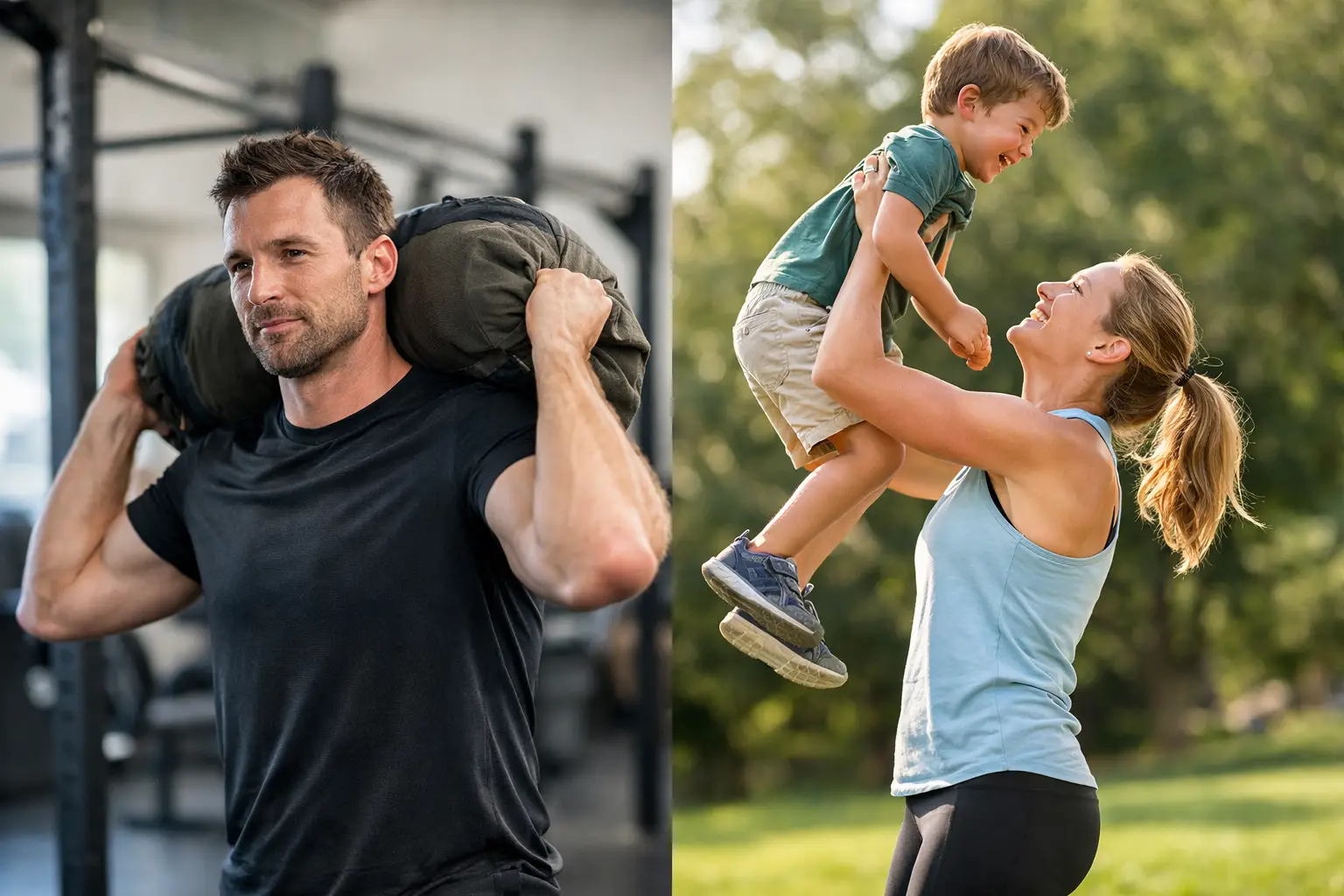
A heavy deadlift can feel satisfying, but it is not the only sign that you are getting stronger. Functional strength shows up when you carry groceries without shifting your weight, get up from the floor comfortably, lift a suitcase into the car, or keep your back from aching after a long day at your desk. Learning how to build functional strength means training for the movements and responsibilities your real life asks of you – not chasing exhaustion or a number on the scale.
For busy adults, this approach can be a relief. You do not need a perfect gym routine or two-hour workouts. You need a few foundational movement patterns, a plan for gradual progress, and enough recovery to keep showing up.
Table of Contents
- What functional strength actually means
- How to build functional strength step by step
- A simple weekly functional strength plan
- Common mistakes that slow progress
- FAQ
What Functional Strength Actually Means
Functional strength is the ability to move your body with control, power, stability, and confidence in daily life. It combines muscular strength with balance, mobility, coordination, and core control. A strong body is useful, but a body that can squat, hinge, push, pull, rotate, carry, and move in different directions is better prepared for the unpredictable moments of work, parenting, travel, hobbies, and aging.
This does not mean traditional strength exercises are somehow less valuable. Squats, presses, rows, and deadlifts are excellent tools. The difference is in how you use them. Rather than training only to lift the heaviest possible weight in one narrow movement, functional training asks whether that strength carries over to the life you want to live.
Your needs will vary. A parent may want to lift a toddler repeatedly without aggravating their back. A nurse or warehouse worker may need stamina and safe lifting mechanics through a long shift. Someone in their 60s may prioritize getting up from a chair, improving balance, and feeling steadier on stairs. All of these goals count.
How to Build Functional Strength Step by Step
1. Start with the movement patterns you use most
Build your workouts around a handful of foundational patterns: squat, hinge, push, pull, carry, rotate or resist rotation, and locomotion such as walking, stepping, or crawling. These patterns involve multiple joints and muscle groups, which makes them efficient when time is limited.
A squat can look like a bodyweight sit-to-stand from a chair, a goblet squat, or a weighted step-up. A hinge may be a glute bridge, kettlebell deadlift, or Romanian deadlift. Pushing includes incline push-ups and overhead presses; pulling includes resistance-band rows and dumbbell rows. Carries can be as simple as holding two moderately heavy bags and walking slowly with good posture.
Choose versions that match your current ability. Starting with a chair squat is not settling for less. It is practicing a meaningful skill at a level where you can build confidence and good form.
2. Train control before you chase intensity
Functional strength is not just about producing force. It is also about controlling force. Lower yourself slowly into a squat, pause at the bottom of a lunge, or hold steady during a plank before adding more weight or more repetitions.
This matters especially if you have been inactive, are returning after injury, or spend much of the day seated. Your muscles may be ready to work before your joints and coordination are ready for fast, high-volume training. Moving with control gives you feedback: Can you keep your knee aligned? Can you keep your ribs stacked over your pelvis? Can you breathe without bracing every muscle in your body?
A useful rule is to finish most sets feeling like you could complete two or three more good repetitions. This leaves room for practice, reduces the urge to train through sloppy form, and makes consistency more likely.
3. Include single-leg and side-to-side work
Daily life rarely happens with both feet planted evenly on the floor. You step off curbs, climb stairs, reach into the back seat, and turn to grab something from a shelf. Single-leg and lateral movements can help prepare you for those demands.
Try step-ups, split squats, supported single-leg deadlifts, or lateral lunges. You do not need to make these exercises complicated. Holding onto a wall or chair while learning a movement is a smart way to build stability, not a sign that you are failing.
If one side feels noticeably less coordinated or weaker, begin there and match the repetitions on your stronger side. The goal is not perfect symmetry. It is better awareness and more reliable movement.
4. Make carries a regular part of your training
Carries are one of the most practical strength exercises available. They train your grip, shoulders, core, posture, hips, and gait while requiring you to stay upright under load.
Start with a farmer carry: hold a dumbbell, kettlebell, or heavy household object in each hand and walk for 20 to 40 seconds. Keep your shoulders relaxed rather than shrugged, take controlled steps, and avoid leaning side to side. A suitcase carry, with weight in one hand, adds an anti-rotation challenge and can reveal how well you stabilize through your trunk.
The load should feel challenging without changing the way you walk. If you are limping, holding your breath, or tilting sharply, reduce the weight or shorten the distance.
5. Progress one variable at a time
Your body adapts when training gradually becomes more demanding. The mistake is assuming progress must mean adding weight every workout. You can also add a repetition, an extra set, a few seconds of carrying, a slower lowering phase, or a slightly more challenging exercise variation.
For example, you might begin with two sets of eight chair squats. After a week or two, move to three sets of eight. Later, hold a light dumbbell at your chest. Small changes are easier to recover from and easier to sustain during hectic seasons.
Keep a brief log in your phone or notebook. Record the exercise, weight or variation, sets, repetitions, and how it felt. This is not about obsessing over data. It helps you notice real progress on the days motivation is low.
6. Support strength with recovery and everyday movement
Strength grows during recovery, not only during workouts. Sleep, enough food, hydration, and lower-stress movement all matter. If you are under deadline pressure, caring for family, or working rotating shifts, a shorter workout may be the more functional choice for your life right now.
Aim for protein-containing meals throughout the day, especially after training, and include carbohydrates to support activity and recovery. You do not need a restrictive food plan to get stronger. You need enough consistent fuel.
Walking also supports functional capacity. It builds a base of movement, helps you practice a natural gait pattern, and can ease the stiffness that comes from long periods of sitting. Ten minutes between meetings or after dinner still counts.
A Simple Weekly Functional Strength Plan
Two or three full-body sessions each week is enough for many people to make meaningful progress. Leave at least one day between harder sessions when possible. Each session can take 25 to 40 minutes.
- Squat: Chair squat, goblet squat, or step-up – 2 to 3 sets of 6 to 12 repetitions.
- Hinge: Glute bridge, kettlebell deadlift, or Romanian deadlift – 2 to 3 sets of 8 to 12 repetitions.
- Push and pull: Incline push-up plus band or dumbbell row – 2 to 3 sets of 6 to 12 repetitions each.
- Single-leg or lateral movement: Split squat, supported single-leg deadlift, or lateral lunge – 2 sets of 6 to 10 repetitions per side.
- Carry or core stability: Farmer carry, suitcase carry, dead bug, or plank – 2 to 3 rounds.
Warm up with a few minutes of easy walking, shoulder circles, hip movements, and practice repetitions of your first exercise. The best warm-up is one that helps you feel more prepared, not one that leaves you tired before the session begins.
Common Mistakes That Slow Progress
The first mistake is treating every workout like a test. Constantly pushing to failure can make you sore, discouraged, and more likely to skip the next session. Train hard enough to create change, but not so hard that fitness becomes another source of burnout.
The second is copying advanced routines before you own the basics. Unstable surfaces, complicated circuits, and high-speed movements can be useful in the right setting, but they are not automatically more functional. A controlled squat, hinge, row, and carry will serve most people better than a flashy exercise done without control.
Finally, do not ignore pain. Normal muscle fatigue and mild post-workout soreness are different from sharp pain, joint pain, numbness, or symptoms that worsen as you train. Modify the movement, reduce the load, or seek guidance from a qualified health professional when needed.
FAQ
How often should I train for functional strength?
Two full-body sessions per week is a strong starting point. Three sessions can work well if you recover comfortably. The best frequency is one you can maintain through busy weeks, not just when your schedule is unusually calm.
Can I build functional strength at home?
Yes. Bodyweight exercises, resistance bands, a sturdy chair, stairs, and a pair of dumbbells can cover most foundational patterns. Household items can work for carries, but make sure they are secure and easy to hold.
Is functional strength training good for beginners?
Yes, because exercises can be scaled to almost any starting point. A beginner can practice sit-to-stands, wall push-ups, band rows, and supported balance work, then progress gradually as control and confidence improve.
Do I need heavy weights to get functional strength?
Not at first. Lighter resistance can build coordination, endurance, and movement quality. Over time, gradually heavier loads are helpful for building strength, especially for bone health and everyday lifting capacity, but form and progression matter more than rushing the weight.
Functional strength is built through ordinary, repeatable choices: a few well-chosen movements, patient progress, and respect for your recovery. Start where you are, train for the life you actually live, and let consistency do the work.
For more exercise tips, read The Resilient Athlete: A Self-Coaching Guide to Next Level Performance in Sports & Life by Andrejs Birjukovs.