
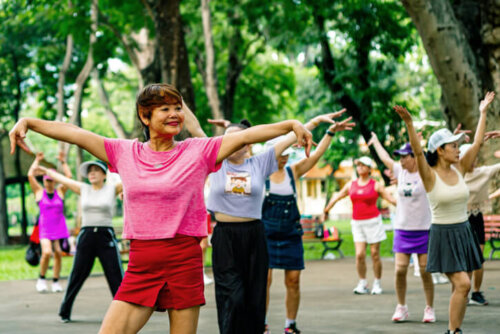
What do you want to be physically capable of at 80 or 90? Not how you want to look. Not your pace. What you want to be able to do.
I thought I knew what I was training for — until a book stopped me in my tracks. Not a doctor, not a trainer, but a book: Dr. Peter Attia’s Outlive. That one question undid me.
I sat with it and realized I’d never actually asked it of myself. I’d been training for the summer, for a ski trip, for the vague goal of “staying fit.” But for my 80-year-old self? I hadn’t given her much thought — though I have a feeling she’s been giving plenty of thought to me. The moment I started planning for the body I wanted decades from now, everything changed.
Meet Your Future Self
Attia calls it the Centenarian Decathlon — your personal list of 10 physical things you want to be capable of in the last decade of your life. Not competitive feats. Everyday ones. The things that define independence, joy, and connection.
Mine looked like this: skiing with future grandchildren. Hiking mountain trails with my husband, Bill. Cycling through wine country. Getting up and down off the floor to play with our dog. Carrying my own luggage through airports. Traveling without physical limitations. Sitting comfortably on the ground at a picnic. Walking miles without pain. Keeping up with the people I love on any adventure they propose.
Reading that list back, I felt something shift. This wasn’t about vanity or performance anymore. This was about freedom — about showing up fully for the life I intend to keep living.
The Math That Changes Everything
Here’s where it gets real — and, truthfully, a little uncomfortable. Research on sarcopenia, the age-related loss of muscle, consistently shows we lose roughly 8–10% of our physical capacity per decade after our peak years. That decline accelerates if we’re sedentary and slows significantly if we’re not. But it doesn’t stop.
So the math runs backward. If you want to carry a 20-pound bag through an airport at 85, you need to be able to carry 40 today. If you want to hike 4 miles at 80, you need to be hiking 8 or more now. Whatever you want to do then, plan on roughly twice the capacity for it now.
That number — twice — landed on me like a weight. Fittingly, since a weight was exactly what it was telling me to go pick up. Not panic. Stone-cold clarity. I wasn’t training to maintain where I am; I was building a reserve, a buffer against the decades ahead.
I stopped training to stay. I started training to last.
And here’s the quiet advantage of doing this in your 50s and 60s: younger athletes don’t have the perspective to train this intentionally. At 30, you train for how you look or how fast you go. Later, you can train for something far more meaningful — the specific life you’re designing for your future self. That’s not a consolation prize. That’s wisdom as strategy.
Which is why strength training is non-negotiable. Muscle is the foundation for nearly everything on a Centenarian Decathlon list — carrying, climbing, rising from the floor, absorbing a stumble without a fracture. The research is unambiguous: the stronger you are in your later decades, the more capable and independent you remain.
Name, Claim & Reframe® Your Future Self
NAME: “What am I actually training for?”
Name the vagueness. Most of us are training for a feeling — a general sense of health — without a clear picture of what we’re building toward. That’s not a criticism. It’s an invitation to get specific.
CLAIM: “I am training for my 80-year-old self. I value capability and freedom decades from now.”
Own the long game. This isn’t about shrinking or maintaining. It’s about arriving at 80 with something in reserve — the strength, the stamina, the bone density to do what you love with the people you love.
REFRAME: “Every workout is a deposit in my future capability account. This is not vanity. This is vision.”
That language matters. Vanity gets you to the gym in January. Vision gets you there in February — and every February after. When you know exactly who you’re training for — that woman on the ski slope, on the trail, on the floor with the grandchildren — showing up gets a whole lot easier.
Design Your Centenarian Decathlon
Step 1: Write your list. What are the 10 physical things you want to be capable of at 80 or 90? Be specific. Not “stay active” — but “hike five miles,” “get up from the floor unassisted,” “carry my own bags.” Your list is yours. There’s no right answer.
Step 2: Do the math. For each item, roughly double the capacity. That’s your training target today. Not to scare you — to focus you. Now you know what you’re building toward.
Step 3: Make her your why. Put your list somewhere you’ll see it. Before a workout you don’t feel like doing, read it. Your 80-year-old self is counting on the choices your current self makes today. That’s not pressure — that’s partnership.
She’s not watching to judge you. She’s counting on you. So pick up the heavier weight.
Andrea Mein DeWitt, M.Ed., PCC, CPCC, is the Global Authority on Cognitive Reframing and author of Name, Claim & Reframe: Your Path to a Well-Lived Life, recognized by NBC’s TODAY Show as 2023’s best motivational read (now available as an audiobook), and the companion Name, Claim & Reframe Workbook, that provides practical exercises for applying these principles. Through her coaching, workshops, and writing, she helps ambitious professionals transform their perspectives to unlock their full power and potential. Learn more at andreadewittadvisors.com.