
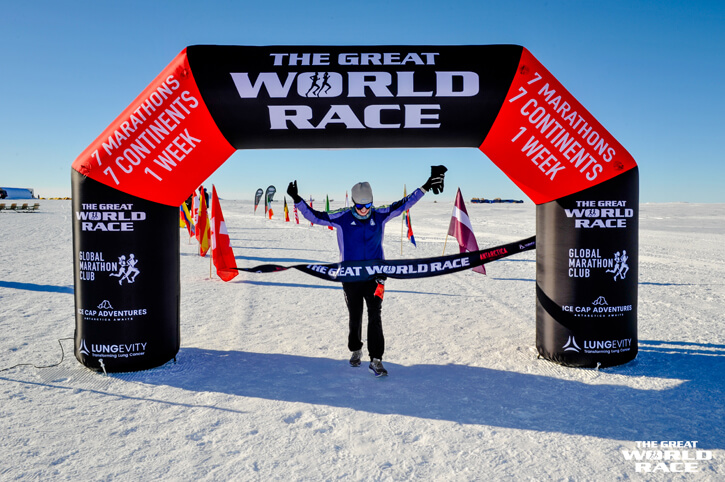
The waiver for Antarctica was not especially comforting.
In fact, according to Ellen Hunter Gans, it essentially boiled down to a simple message: if something goes wrong on the frozen continent, you’re on your own.
For many people, such a warning would serve as a compelling reason to stay home. For Gans, a lifelong traveler, writer, mother, and increasingly ambitious endurance athlete, it was strangely appealing. After all, what could be more extraordinary than starting a marathon on the most remote continent on Earth?
A short time later, she found herself standing on the starting line of the Great World Race, an event that sounds less like a marathon competition and more like the plot of an adventure novel. Participants would run seven marathons on seven continents in seven consecutive days. Between races they would board planes, cross oceans, navigate time zones, sleep when they could, and attempt to recover before doing it all over again the next morning.
The route would take them from Antarctica to Africa, Australia, Europe, Asia, South America, and finally North America. The challenge promised fatigue, uncertainty, and more than a few moments of self-doubt. What it ultimately delivered, however, was something deeper: a powerful reminder of what ordinary people are capable of when they stop waiting for the perfect time to begin.
Not Built for Running
One of the more surprising aspects of Gans’ story is that she does not describe herself as a natural athlete.
In a culture that often celebrates prodigies and champions, her athletic origin story feels refreshingly ordinary. She recalls a single year of junior varsity track in high school and jokes that her coach probably never learned her name. While she grew up surrounded by talented athletes, she never felt she possessed the same gifts.
What she did have was stubbornness.
That characteristic would become her greatest athletic asset.
More than 20 years ago, while studying abroad in London, she decided she would train for a marathon. Her family, reasonably enough, suggested that perhaps she should start with a 5K. Gans ignored the advice and signed up for the marathon anyway.
Like many runners, she discovered that finishing one marathon didn’t satisfy her curiosity. Instead, it created new questions.
What else might be possible?
Another marathon followed. Then another. Eventually dozens.
The challenges became longer. Ultramarathons replaced traditional road races. Distances stretched from marathon lengths to 50 miles, then 100 miles and beyond. Through it all, she remained convinced that her success had less to do with talent than persistence.
She wasn’t the fastest runner in the field. She didn’t expect to be. Her goal was simpler. Keep moving forward.
A Social Media Advertisement and a Wild Idea
The road to the Great World Race began in a surprisingly modern way.
An Instagram advertisement appeared in Gans’ feed while she was training for what was supposed to be her first 100-mile race. The advertisement promoted an event that seemed almost absurd: seven marathons. Seven continents. Seven days.
For reasons she still finds difficult to explain, the idea immediately captured her imagination.
Part of the appeal was travel. A self-described adventure enthusiast and admirer of polar explorer Ernest Shackleton, Gans was especially intrigued by the opportunity to run in Antarctica. The race promised not merely a physical challenge but a journey around the world.
Then came the next challenge: convincing her sister-in-law and longtime running partner, Sarah Hunter.
It didn’t take much.
The two were attending a Foo Fighters concert when Gans casually mentioned she was considering abandoning their planned 100-mile race in favor of the Great World Race. Rather than questioning the decision, Hunter immediately wanted in.
By the end of the conversation, both had effectively rewritten their racing calendar. The original 100-mile event was out. A global marathon adventure was in.
They would later learn they were among the last people to sign up.
Most participants had spent a year preparing. They had only months.
Racing Around the World
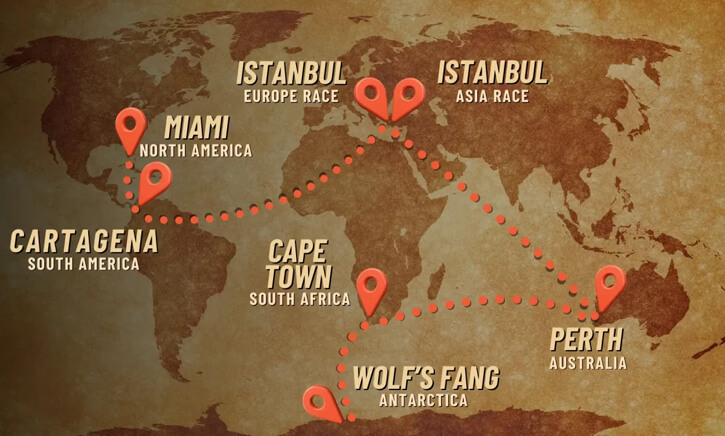
Trying to explain the logistics of the Great World Race almost requires a map.
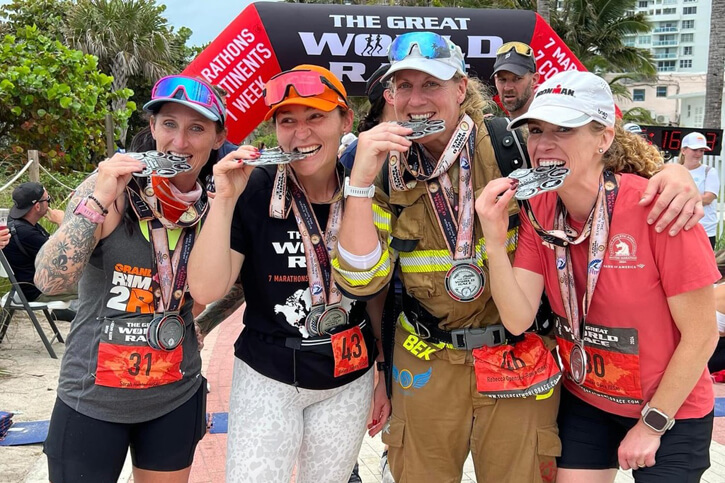
The event began in Antarctica before moving back to Cape Town, South Africa. Then came Perth, Australia. From there runners traveled to Istanbul, where they completed separate races on both the European and Asian sides of the Bosporus. Colombia represented South America before the event concluded in Miami.
The distances were daunting. The travel schedule was almost harder to comprehend.
Participants often had only hours on the ground before boarding another plane. Sleep became fragmented. Time zones blurred together. Days merged into one another. Somewhere between Antarctica and Miami, many runners stopped being entirely certain what day it was—or occasionally where they were.
Yet there was something oddly magical about the experience. The charter aircraft became a traveling home.
Seats transformed into recovery stations. Hotel lobbies became makeshift training rooms. Airport terminals became gathering places where runners compared blisters, taped injuries, and shared stories about the race they were collectively surviving.
When people describe endurance sports, they often focus on suffering.
What Gans remembers most is community.
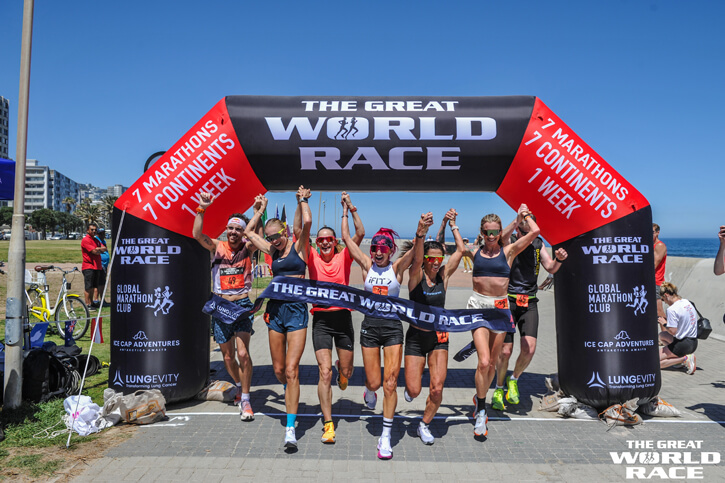
The People Who Made the Story Worth Telling
The race attracted a remarkable collection of individuals:
Olympians were there.
World-record holders were there.
Elite ultrarunners were there.
But those were not necessarily the participants who left the deepest impression.
Among the competitors were two lung cancer survivors, each running with only one lung. Both completed the challenge. Another participant was living with terminal brain cancer and had committed himself to raising unprecedented amounts of money for medical research through endurance events.
There was an 18-year-old competitor and participants approaching 80 years of age. One runner had never officially completed a marathon before arriving in Antarctica. Another had recently traveled to the South Pole.
Their backgrounds differed.
Their life experiences differed.
Their athletic abilities differed.
What united them was a willingness to confront discomfort and uncertainty.
Everyone on that plane had chosen to attempt something difficult.
Everyone had a reason.
As a writer, Gans found herself fascinated by those stories. Long before she considered turning her experience into a book, she was listening carefully to fellow competitors, documenting conversations, and collecting memories. She became convinced that the race was about far more than marathon running.
The real story was human resilience.
When Things Go Wrong
No plan survives contact with reality.
The Great World Race proved no exception.
In fact, organizers had to move the entire schedule forward by a day with little notice, forcing participants to adjust immediately. Considering the complexity of coordinating dozens of runners, international flights, local race operations, medical support, and customs requirements across multiple continents, it was a remarkable logistical achievement that the event functioned at all.
There were personal setbacks as well.
Gans lost her wallet during the journey. Identification cards disappeared. Credit cards vanished. Had her passport still been inside, the race might have ended immediately. Fortunately, Sarah Hunter had agreed to carry the passports for safekeeping. That simple decision prevented a potential disaster.
There were weather challenges.
Travel complications.
Exhaustion.
In one particularly memorable moment, participants who still needed a small amount of mileage to complete their Antarctica race calculated the length of the aircraft aisle and proceeded to walk back and forth until they officially finished their distance requirement before takeoff.
Absurd problems demanded creative solutions.
The race became a week-long exercise in adaptation.

Heat, Rain, and Spider Bites
Every continent presented a different obstacle.
For Hunter, the most difficult race occurred in Cartagena, Colombia.
The heat and humidity were almost overwhelming. Conditions were so severe that race officials stationed large containers of ice water at aid stations. Runners submerged their arms deep into the ice in an effort to lower core body temperatures before continuing. Many stuffed ice under hats or into clothing to stay cool enough to finish.
For Gans, the toughest experience came in Istanbul.
The race unfolded in darkness, wind, and rain. Slippery surfaces complicated footing. Fishermen lined portions of the course, casting lines overhead while runners attempted to navigate narrow paths through the night.
Then came a mystery.
Intense pain developed in the back of her leg. Nausea followed.
Only later did she realize she had likely been bitten by a spider earlier in the day. The symptoms became another challenge to manage while completing a marathon on the opposite side of the world.
Yet despite the discomfort, she kept moving.
That decision reflected a philosophy she has carried throughout her athletic life. Once she starts, she finishes.
She notes with some pride that she has never recorded a “Did Not Finish” in any race she has entered. Her performances are not always fast. They are not always pretty. But she finishes.
Living with Ehlers-Danlos Syndrome
Pain, however, is not an occasional visitor in Gans’ life.
It is a constant companion.
She lives with hypermobile Ehlers-Danlos Syndrome (EDS), a genetic connective tissue disorder that affects joints, ligaments, tendons, and numerous systems throughout the body. The condition can create instability, chronic pain, fatigue, and countless other complications.
Diagnosis is often difficult.
Many patients spend years searching for answers because symptoms overlap with numerous other conditions. Gans notes that women frequently face even longer delays before receiving a formal diagnosis.
For her, EDS means daily pain management.
It means braces. Physical therapy. Preparation. Careful monitoring of symptoms. Calculated risks.
She is also quick to acknowledge that her experience represents only one version of the condition. Others face far greater limitations and challenges. Her goal in discussing EDS publicly is not to suggest everyone should be running marathons, but rather to increase awareness about a frequently misunderstood disorder.
If sharing her story encourages even one person to seek answers about unexplained symptoms, she believes it will have been worthwhile.
Why Nobody Quit
Ask endurance athletes how they survive seemingly impossible events and their answers are rarely complicated.
Hunter views the challenge in manageable pieces.
One loop.
One aid station.
One mile at a time.
Gans approaches things somewhat differently.
She removes stopping as an option.
The moment quitting disappears from consideration, the question becomes less about whether to continue and more about how.
Of course, neither approach works alone.
One of the race’s most remarkable characteristics was the support system participants created for one another. By the second day, runners were cheering each other by name. Competitors monitored one another’s health, shared supplies, offered encouragement, and celebrated every finish regardless of pace.
Within a week, the atmosphere felt less like a sporting event and more like summer camp for adults who enjoy extreme challenges. Many participants remain close friends today.
Group messages still buzz. New adventures are constantly proposed.
Someone is always training for another impossible-sounding event somewhere in the world.
The race ended. The community did not.
More Than a Running Story
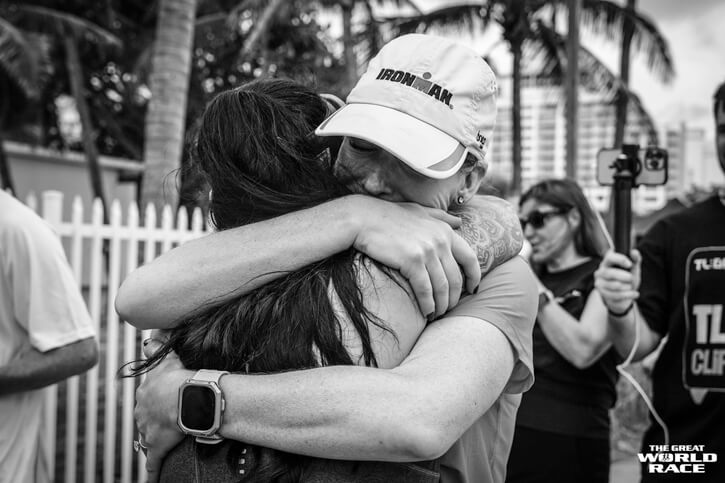
When Gans eventually sat down to write Seven Marathons, Seven Continents, One Week, she approached the project as she would any story worth telling.
She looked for people.
Professional writers understand that facts matter, but characters matter more. The mileage, race results, and travel itineraries provide structure. The human stories provide meaning.
That realization shaped the entire book. Yes, readers will learn how a group of runners traversed the globe in a week. They will learn about Antarctica. Jet lag. Blisters. Logistics. Endurance. But beneath all of that lies another message.
The most interesting thing about the Great World Race was never the marathons. It was the people willing to attempt them.
If Not Now, When?
During a discussion following the book’s publication, one participant in the race told Gans that reading the manuscript reminded her she could still do hard things.
For the author, that reaction represented success. Not because the book sold a copy. Not because it validated her writing. Because it captured the central lesson of the entire experience.
Throughout the race, one question surfaced repeatedly:
If not now, when?
Most people will never run seven marathons on seven continents. Many have no desire to. That’s perfectly fine.
The lesson transcends running.
Everyone has some version of the challenge sitting quietly in the back of their mind—a business idea, a trip, a creative project, a career change, a personal goal they’ve postponed until circumstances become ideal.
The Great World Race offers a different perspective.
Ideal circumstances rarely arrive.
Life rarely becomes less complicated.
Dreams rarely move closer while sitting still.
Seven marathons in seven days across seven continents is an extreme example, but its underlying message is simple. The extraordinary is often achieved by ordinary people who decide to begin before they feel completely ready.
Ellen Hunter Gans would likely be the first to insist she is not a superstar athlete. She remains a writer who loves stories, a mother balancing responsibilities, and a woman managing a chronic medical condition while pursuing adventures that happen to involve running long distances.
Perhaps that’s precisely why her story resonates.
Because in the end, the race wasn’t won in Antarctica, Istanbul, Cartagena, or Miami.
Postscript: From Finish Line to Printed Page
The experience of the Great World Race might have ended in Miami, but for Ellen Hunter Gans, the story was only beginning.
A professional writer for much of her career, Gans spent years crafting executive communications, corporate narratives, and thought leadership pieces. Yet the events of November 2024 presented a different kind of challenge: how do you capture seven marathons, seven continents, and dozens of unforgettable human stories in a way that does justice to the experience?
The result is Seven Marathons. Seven Continents. One Week.: The Remarkable Race of Endurance, Grit, and Self-Discovery. More than a race report, the book blends travel adventure, personal memoir, and profiles of the extraordinary individuals who shared the journey. Readers will encounter Olympians, cancer survivors, first-time marathoners, elite ultrarunners, and everyday people united by a willingness to pursue something difficult and uncertain.
Gans has said that writing the book was never intended to be solely about her own accomplishment. What fascinated her most were the other participants—their motivations, their hardships, and the life experiences that brought them to a charter plane circling the globe in pursuit of a seemingly impossible goal. Those stories became the heart of the book.
For runners, the book offers a behind-the-scenes look at one of the world’s most demanding endurance events. For non-runners, it serves as a reminder that adventure is not reserved for elite athletes. The broader message is one that echoes throughout the race and the book itself: life’s most meaningful experiences often begin when we stop waiting for ideal conditions and take the first step anyway.
As one question repeatedly surfaced during the journey—and ultimately became a guiding theme of the narrative:
If not now, when?
Seven Marathons. Seven Continents. One Week.: The Remarkable Race of Endurance, Grit, and Self-Discovery by Ellen Hunter Gans is available through major booksellers and online retailers.
For more information, visit sevenmarathonsbook.com.
Photos from The Great World Race were taken by Mark Conlon