
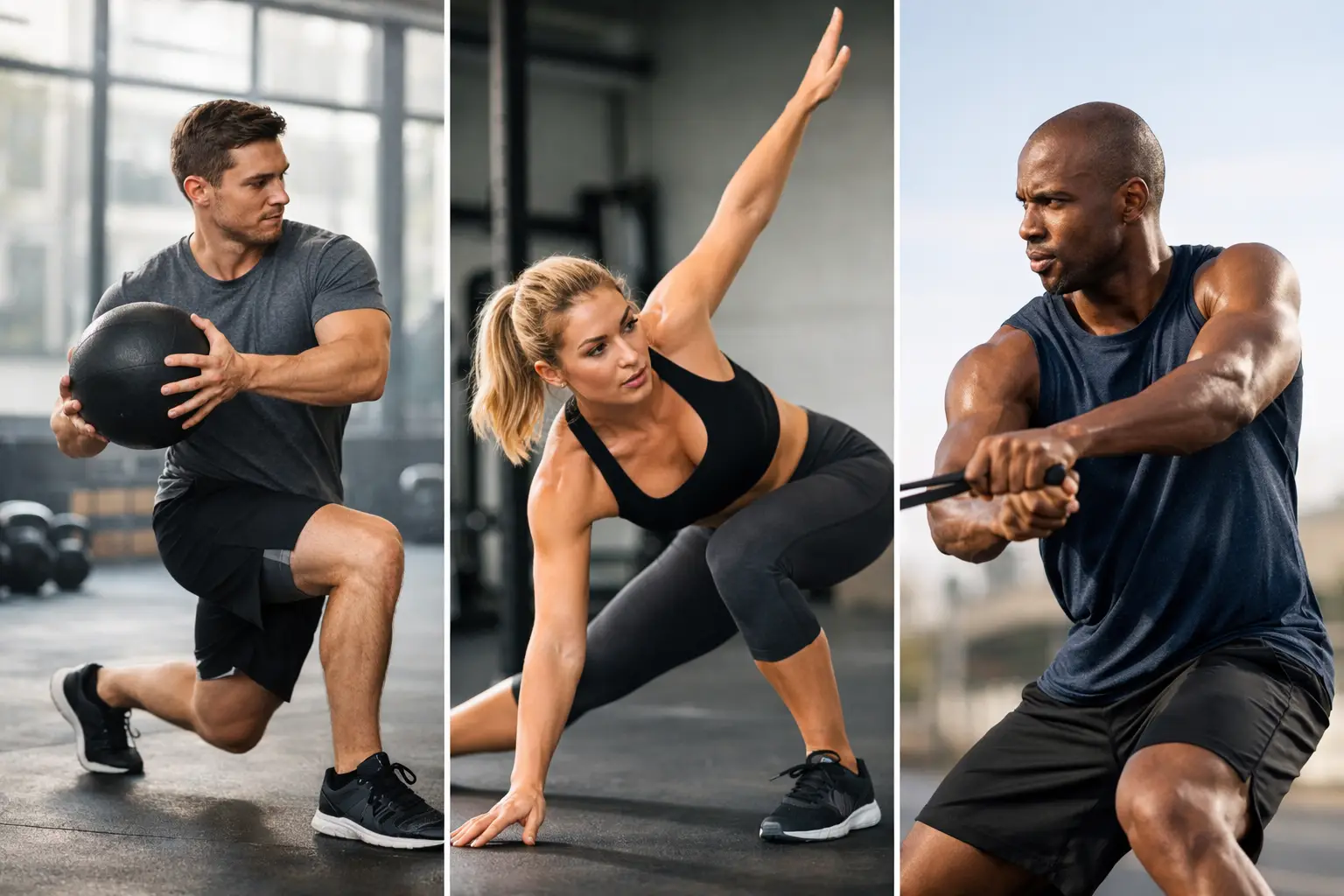
Your body does not move in neat, straight lines when you lift a child into a car seat, reach for a bag in the back seat, turn quickly to answer a coworker, or step around a toy on the floor. Multi-planar movement exercises help you practice the kind of strength, control, and mobility those everyday moments require – without needing to make your workouts longer or more complicated.
For many people, training happens in the small windows around work, family, and recovery. That makes it worth choosing movements that give you more than one benefit at a time. Training across different directions can build a more adaptable body, especially when you pair it with good technique and a pace that fits your current energy.
Table of Contents
- What multi-planar movement means
- Why different planes matter in daily life
- Eight multi-planar movement exercises to try
- How to program them without overdoing it
- Common form mistakes
- Frequently asked questions
What are multi-planar movement exercises?
Movement is often described in three planes. The sagittal plane includes forward-and-back actions, such as squats, lunges, walking, and deadlifts. The frontal plane includes side-to-side actions, such as lateral lunges and side steps. The transverse plane involves rotation, like turning, throwing, or reaching across your body.
Most classic gym exercises focus mainly on the sagittal plane. That is not a problem – squats, presses, and hinges are valuable foundations. But daily life asks you to move in all three planes, often at once. Multi-planar movement adds side-to-side and rotational patterns so your routine better reflects how you actually use your body.
This is not about making every exercise look athletic or complicated. It is about building options: the ability to step, brace, rotate, decelerate, and regain balance with more confidence.
Why training in different directions can help
A body that only practices straight-ahead movement can still be strong. But adding variety may improve coordination, joint awareness, balance, and confidence during unpredictable tasks. Think of it as giving your hips, ankles, core, and shoulders more chances to work together.
That said, more variety is not automatically better. If you are new to exercise, returning after pain, or carrying a lot of stress, a well-controlled squat and walk may be more useful than a fast rotational circuit. The right starting point depends on your experience, current mobility, and recovery capacity.
8 multi-planar movement exercises to build into your week
Start with body-weight or a light load. Your goal is not to create the biggest range of motion possible. It is to move smoothly, keep control, and stop before form starts to fade.
Lateral lunge
Stand tall with your feet together. Step one foot wide to the side, sit your hips back, and bend the stepping knee while keeping the other leg relatively straight. Push through the bent leg to return to standing. This trains side-to-side hip strength and can be especially useful for people who spend much of the day seated.
Keep your knee tracking in the same direction as your toes. If your hips feel tight, shorten the step and use a chair or countertop for light support.
Reverse lunge with a reach
Step one foot back into a reverse lunge. As you lower, reach both arms slightly forward and toward the outside of your front leg. Return to standing with control, then repeat on the other side. The lower body works in a familiar forward-and-back pattern while the reach introduces a gentle rotational demand.
Move slowly enough that your front foot stays grounded. A reach should help you coordinate, not pull you off balance.
Skater step
Shift your weight onto one leg, step the other foot diagonally behind you, and tap the floor lightly. Return to center before switching sides. Unlike a jumping skater, this low-impact version lets you practice lateral control without asking your joints to absorb impact.
Use a smaller step if you notice your knee collapsing inward. As you get stronger, hold a light dumbbell at your chest or add a longer pause at the bottom.
Split-stance cable or band chop
Stand in a staggered stance with a resistance band anchored around shoulder height. Pull the band diagonally across your body toward the opposite hip while keeping your ribs stacked over your pelvis. Let your upper body rotate slightly, but avoid twisting hard through your low back.
This exercise teaches your core to transfer force between your hips and shoulders. It is a practical alternative to doing endless crunches, especially if your goal is to feel steadier while carrying, reaching, or lifting.
Step-up with knee drive
Step onto a stable box or stair with your whole foot. Stand tall at the top and bring the opposite knee forward and up, pausing briefly before stepping down. The step-up develops single-leg strength, while the knee drive challenges balance in a way that walking upstairs often does.
Choose a height that allows you to stay in control. If you have to push hard off the floor with your trailing leg, lower the step.
Single-leg Romanian deadlift with reach
Stand on one leg with a soft bend in the knee. Hinge at the hips as your free leg reaches behind you and your opposite hand reaches toward the floor or a wall in front of you. Return to standing by pressing the floor away.
This exercise can feel humbling, and that is normal. Begin with fingertips on a wall or perform a kickstand version with the back toes lightly on the floor. Balance improves through practice, not by forcing yourself to wobble through every rep.
Bear plank shoulder tap
Start on hands and knees, then lift your knees an inch or two from the floor. Without shifting your hips dramatically, tap one hand to the opposite shoulder and alternate sides. Your torso resists rotation while your shoulders and hips stabilize.
For a more accessible version, do shoulder taps from an incline with your hands on a bench, counter, or sturdy table. Keep the movement quiet and controlled rather than racing through repetitions.
Half-kneeling lift
Kneel with one knee down and the other foot planted in front. Hold a light dumbbell, medicine ball, or band near the hip of the kneeling side, then guide it upward and diagonally across your body. Your hips stay mostly still while your trunk and shoulders coordinate the lift.
The half-kneeling position reduces the temptation to compensate with your legs and lower back. It can be a helpful way to learn rotational control before trying standing variations.
How to build these multi-planar movements into a realistic routine
You do not need all eight exercises in one workout. Choose two or three patterns that match your needs, then pair them with your usual strength work. For example, after squats and rows, you might add lateral lunges and bear plank shoulder taps.
A simple approach is to do two or three sets of 6 to 10 controlled repetitions per side. For stability-focused moves, such as the single-leg deadlift or shoulder tap, fewer deliberate reps often work better than high-rep fatigue. Rest enough to feel steady before beginning the next set.
If your schedule is especially full, try a 10-minute movement break: lateral lunges, step-ups, and band chops. One round is still practice. Consistency built around real life will take you further than an ambitious plan you cannot recover from or repeat.
Form cues that protect the purpose of the exercise
Multi-planar training should feel challenging, not chaotic. Use these cues to keep your practice productive:
- Move at a speed you can control, particularly when stepping sideways or rotating.
- Keep your foot connected to the floor and let your knee follow the direction of your toes.
- Create rotation mostly through your upper back and hips, not by forcing your low back to twist.
- Use a smaller range of motion when balance, pain, or stiffness changes your form.
- Stop for sharp pain, dizziness, numbness, or a feeling that a joint is unstable.
Muscle effort, mild shaking, and the unfamiliar feeling of using a new direction can be normal. Joint pain is different. If pain persists or you are returning from an injury, a qualified physical therapist or health professional can help you choose appropriate modifications.
Put the goal in perspective
The purpose of multi-planar training is not to prove that you can perform the most elaborate variation online. It is to make everyday movement feel more supported: getting off the floor, catching yourself on an uneven sidewalk, carrying groceries, playing with your kids, or simply moving through a busy day with less hesitation.
Build from the basics, repeat what feels good, and progress one variable at a time – a slightly deeper range, a little more resistance, or better control. Your body benefits from patient practice far more than punishment.
Frequently Asked Questions
Are multi-planar exercises good for beginners?
Yes, when the version matches your current ability. Begin with supported lateral lunges, low step-ups, and gentle band chops. You do not need heavy weights or fast transitions to get meaningful benefits.
How often should I do multi-planar movement exercises?
Two or three times per week is enough for most people, especially when the movements are included in a balanced strength routine. You can also use a few low-intensity mobility and balance drills on other days.
Can multi-planar training prevent injuries?
No workout can guarantee injury prevention. However, practicing balance, strength, and control in multiple directions may help you feel more prepared for the movements life asks of you. The most helpful routine is one you can perform consistently, recover from, and adjust as your needs change.
What if rotational exercises bother my back?
Skip painful rotation and start with anti-rotation work, such as a bear plank shoulder tap or a band press held at chest height. Keep the range small and focus on steady breathing. A helpful next step is not forcing the movement – it is finding a version that helps you feel capable and secure.