
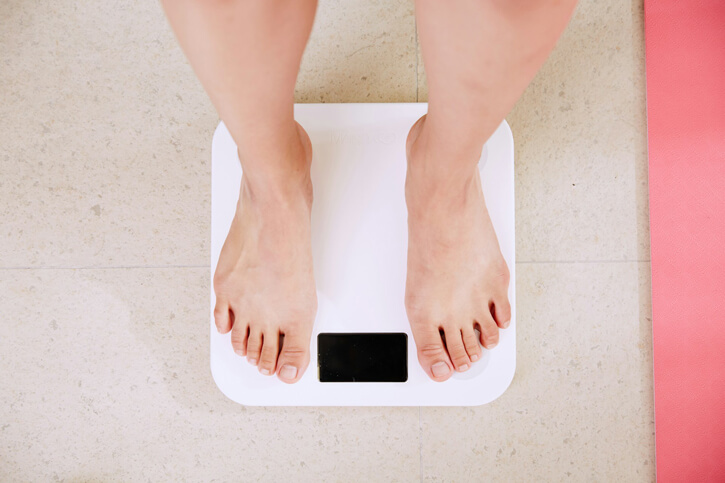
When did a three-digit number become the boss of us?
My clothes have been lying to me. Or maybe — finally — they’ve been telling the truth. Last spring, I pulled on a pair of jeans I hadn’t worn since before I got serious about strength training. They didn’t fit. I nearly spiraled — until I realized they were tight in the thighs and loose in the waist. My body hadn’t gotten bigger. It had reorganized itself.
Meanwhile, the scale? Completely unbothered. Same number, month after month, like it was daring me to care.
For a while, I did care. I was lifting consistently, sleeping better, moving through my days with more energy than I’d had in years. And yet some part of my brain kept whispering: but the number. The scale doesn’t lie.
Except, here’s the thing: in a very important way, it does.
What the Scale Actually Measures
The scale measures your total weight. Full stop. It cannot tell you what that weight is made of — whether it’s fat, muscle, water, or the burrito you had for lunch. It gives you one number when what you actually need is a ratio.
Muscle and fat weigh the same per pound — a pound is a pound — but a pound of muscle is dense and compact, while a pound of fat takes up roughly four times the space. Which is why two people can weigh exactly the same and look — and feel — completely different.
More importantly for those of us navigating our 50s, 60s, and beyond: muscle is metabolically active tissue. It burns calories even when you’re sitting still. Fat, largely, does not. As we age and our metabolism naturally slows, muscle mass becomes metabolic insurance — the thing that keeps your engine running.
Why Cardio Alone Stopped Working
If you’ve been exercising for decades, you may have noticed something frustrating: what worked in your 30s and 40s isn’t delivering the same results. The long runs, the spin classes, the cardio-heavy routines that once kept weight in check seem to have… stopped being an effective strategy.
This isn’t failure. It’s biology. As estrogen and testosterone decline with age, muscle mass naturally decreases — a process called sarcopenia — the age-related loss of muscle that begins as early as 30 and can erase 3–5% of muscle mass per decade. Less muscle means a slower resting metabolism. Cardio burns calories during the workout, but it doesn’t rebuild the metabolic infrastructure that’s quietly eroding.
Strength training does. Lifting weights — or using resistance bands, body weight, whatever form works for you — signals your body to hold onto and build muscle tissue. It’s the long game. Not flashy. Not immediately visible on a scale. But transformative in ways that compound over the years.
It also does something the scale will never reflect: it builds bone. Resistance training creates mechanical stress on the skeleton, which signals the body to maintain and increase bone density — one of the most critical things women can do post-menopause, when estrogen loss accelerates bone loss by as much as 1–2% per year. The weight room isn’t just changing how your clothes fit. It’s building the skeleton that keeps you upright, independent, and on the ski slope at 75.
There’s also a hormonal plot twist most women never hear about. As estrogen declines, the body loses its natural buffer against cortisol — the stress hormone that, when chronically elevated, preferentially stores fat in the abdomen. Long, intense cardio sessions spike cortisol. Estrogen used to blunt that effect; now it largely can’t. The result: more effort, more belly fat, more frustration. And nobody told us.
I know this one personally. As a former distance runner, I ran to release stress — it was my reset button, my therapy, a meditation of sorts. I wasn’t running away from stress. Hormonally speaking, I was running straight into it.
THE ROOM THAT REFRAMED MY THINKING
While the science may get you started, being part of a supportive community is what keeps you going. For most of my life, I was a solo exerciser — headphones in, head down, group fitness filed firmly under not-for-me. Then I walked into my local barre studio, and it changed my body composition and, honestly, my life.
The room wasn’t full of women chasing smaller bodies. It was women of every age building stronger ones — the young mom with a toddler on her hip, the one white-knuckling through perimenopause, the one on the far side of it lifting heavier than she did at 30, the high-school moms wedging a class between drop-off and everything else. All of us in some season of transition. All of us showing up anyway, quietly cheering each other on.
There’s no right body in that room. No right size, shape, or age — just the practice of being healthy, in good company. And that company is what gets me back through the door on the mornings the science alone wouldn’t.
You probably have a community like this near you. An app like Mindbody makes it easy to find the studios and classes nearby — so go find yours. Strength training will change your body; doing it alongside other women changes how it feels to show up for yourself.
A heartfelt shout-out to the women of Barre925 who started all of this for me.
Name, Claim and Reframe® Your NUMBER
- NAME: “Why am I so focused on the scale when my body is clearly changing?”
Name the fixation. Notice the frustration. Let yourself feel how unfair it is to do everything right and still feel like you’re failing because of one number.
- CLAIM: “I value building muscle and changing my body composition. At my age, muscle mass is metabolic insurance — it’s what keeps my metabolism functioning.”
Own the actual goal. Not thinness. Not a number. Strength, function, longevity. The body you want to be living in at 75 and 85 isn’t built by watching a scale — it’s built in the weight room.
- REFRAME: “The scale can’t measure muscle versus fat. My body is building the metabolism-boosting muscle I need as I age. That matters infinitely more than a number. I’m getting stronger — not just smaller.”
This reframe isn’t about giving up on how you look. It’s about understanding that what you’re building — dense, metabolically active muscle tissue — is genuinely invisible to the scale. You’re not failing. You’re changing in ways that measurement hasn’t caught up with yet.
Your 90-Day Experiment
Put the scale away and set a different baseline — one that tracks what your body can do, not what it weighs:
- Strength: Notice what feels manageable now — a weight, a set of stairs, a heavy bag of mulch. In a month, notice again. The shift sneaks up on you.
- Real life: Can you carry the groceries up in one trip? Get off the floor without a hand? Make it up the hill without stopping? Pick two everyday things and watch them get easier.
- Your clothes: Skip the tape measure — just notice how your favorite jeans fit. Your closet keeps better score than any scale.
- Energy: How’s your afternoon? Your sleep? How you feel at 4 p.m. says more than any morning weigh-in.
Then check in monthly for three months and ignore the scale entirely. What you’ll find is a change in your body composition that the scale was never going to show you.

Andrea Mein DeWitt, M.Ed., PCC, CPCC, is the Global Authority on Cognitive Reframing and author of Name, Claim & Reframe: Your Path to a Well-Lived Life, recognized by NBC’s TODAY Show as 2023’s best motivational read (now available as an audiobook), and the companion Name, Claim & Reframe Workbook, that provides practical exercises for applying these principles. Through her coaching, workshops, and writing, she helps ambitious professionals transform their perspectives to unlock their full power and potential. Learn more at andreadewittadvisors.com.